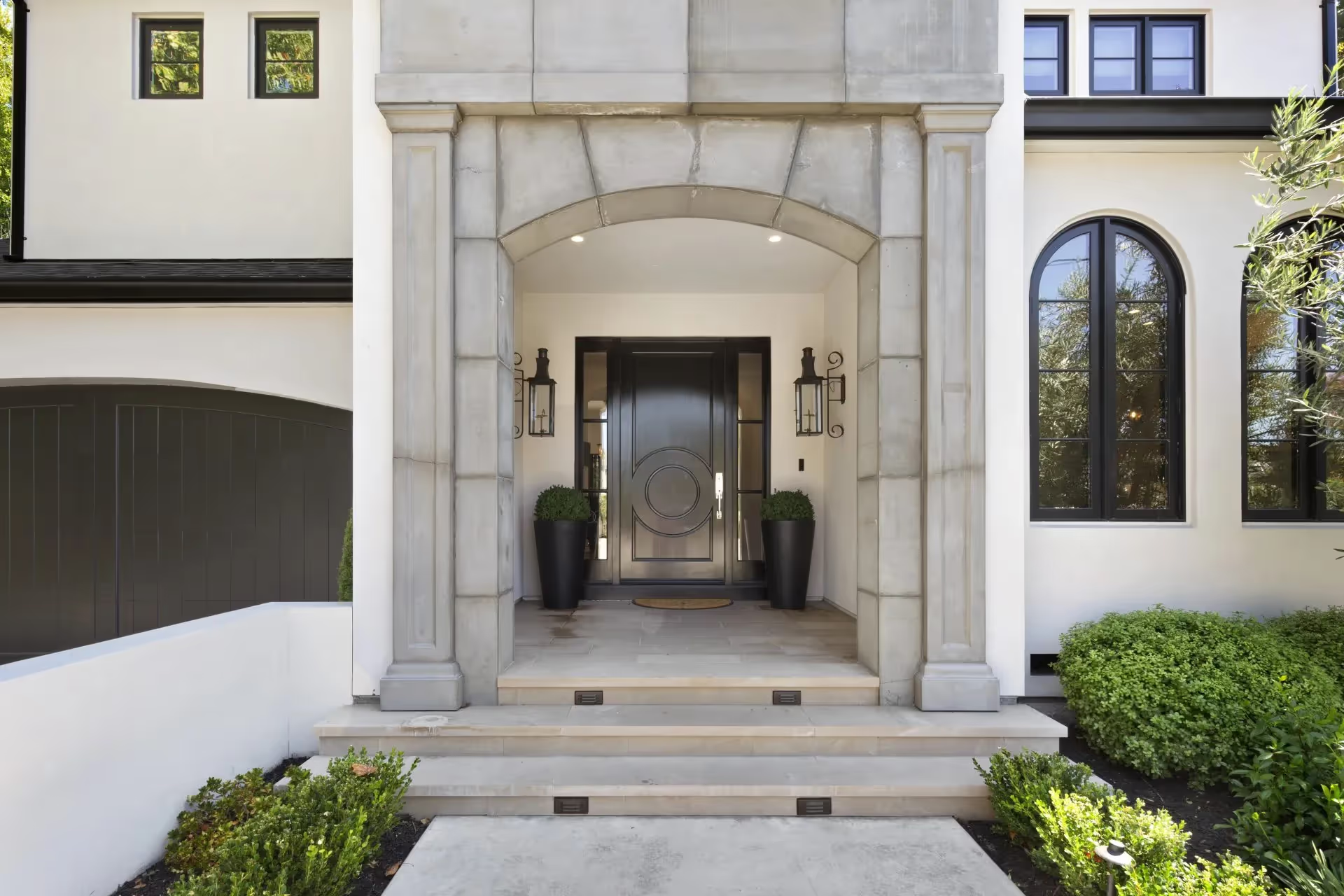
The building envelope, covering foundations, walls, roofs, windows, doors, and all the transitions between them, is the most consequential set of decisions in any luxury custom home. For Bay Area homeowners investing $3M to $8M or more in a custom build, envelope details hidden behind premium finishes determine long-term comfort, energy performance, durability, and structural integrity. Getting them right during construction is far less costly than repairing them afterward.
A $7M home can look flawless at move-in and still be quietly failing behind its walls. Not because of cheap finishes or poor design, but because the building envelope, the system that protects everything inside from everything outside, was never detailed or inspected with the rigor the rest of the project demanded. For families building a forever home in Los Gatos, Palo Alto, or anywhere across the Peninsula, this is the gap between a home that performs for decades and one that starts showing problems in year three.
Key Takeaways
- The building envelope includes every component separating your home's interior from the exterior, and its quality is largely invisible during a standard walkthrough.
- Poor envelope detailing is the leading cause of moisture intrusion, air leakage, and thermal failure in luxury custom homes, often surfacing years after move-in.
- Bay Area microclimates create specific envelope challenges that require local knowledge and precise execution, not just code compliance.
- Remediation costs for envelope failures in high-end homes can reach hundreds of thousands of dollars, largely because premium finishes must be removed to access the underlying problem.
- Asking a builder for third-party test results and photographic documentation from previous projects is the most reliable way to verify envelope quality before you commit.
- A great architectural design only delivers on its promise when the builder executes the envelope details with equal precision in the field.
Things You Must Know
1. The Most Expensive Envelope Failures Are Invisible at Move-In
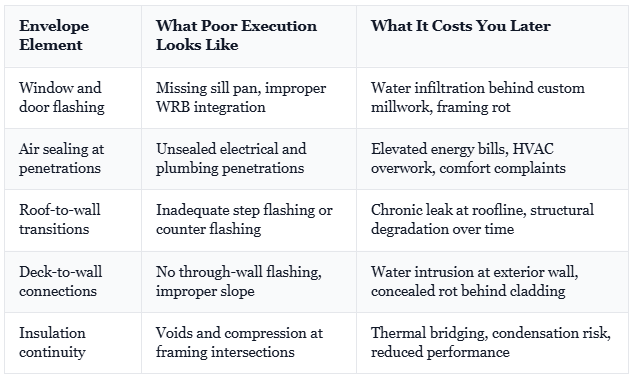
Water intrusion, air leakage, and thermal bridging rarely announce themselves at final walkthrough. They surface two to seven years later as staining behind custom millwork, mold beneath specialty cladding, or unexplained energy bills despite a high-end HVAC system. By the time the symptoms appear, remediation requires removing and reinstalling the very finishes you spent significant budget on. The cost to fix what should have been built correctly the first time is almost always a multiple of what proper detailing would have cost during construction.
2. Code Compliance Is a Floor, Not a Standard of Excellence
California's Title 24 energy code sets a minimum performance threshold. For a family building a home intended to last 30 to 50 years, minimum compliance is not the goal. High-performance envelope assemblies, thorough air sealing, and carefully sequenced water management at every transition represent a meaningfully higher standard, and one that a builder focused on quality behind the walls will pursue by default rather than by request.
3. Envelope Quality Cannot Be Verified After Drywall Goes Up
This is the detail most clients don't fully appreciate until they've been through a difficult build. Once walls are closed, the quality of the flashing, air barriers, and insulation installation is locked in. The window for inspection is narrow and follows a specific construction sequence. Builders who take this seriously will have a documented inspection process at each critical stage, along with third-party testing data. If a builder can't show you evidence of how they approach these stages on previous projects, that absence tells you something important.
What Is a Building Envelope, Exactly?
The building envelope is the physical boundary between the conditioned interior of your home and the exterior environment. It includes the foundation, exterior walls, roof assembly, windows, doors, and every transition point where those systems meet each other.
What makes the envelope so critical isn't any single component. It's the details at the transitions: where the roof plane changes pitch, where a window is flashed into the wall assembly, where a deck connects to an exterior wall, where two different cladding materials meet. These are the points where water, air, and thermal energy find their way in if the work isn't precise.
Why Does This Matter More in a Luxury Custom Home?
In production homes, envelope assemblies are standardized and repeated hundreds of times. The details are familiar to every subcontractor on the site. Custom homes are different by definition. Each project involves unique geometries, custom window and door configurations, specialty cladding systems, and transitions that may never have been built exactly that way before.
That complexity creates more opportunities for error, and the consequences are amplified by the quality of the finishes involved. A moisture intrusion problem in a standard home might mean replacing drywall. The same problem behind hand-applied plaster, custom stone cladding, or a fully integrated smart home system is a fundamentally different remediation challenge.
Water infiltration and air leakage through building envelope failures are among the most commonly cited causes of structural damage in high-end residential construction, with remediation costs in luxury homes frequently exceeding those in standard construction by a significant margin due to the cost of removing and reinstalling premium finishes.
How Bay Area Microclimates Add to the Challenge
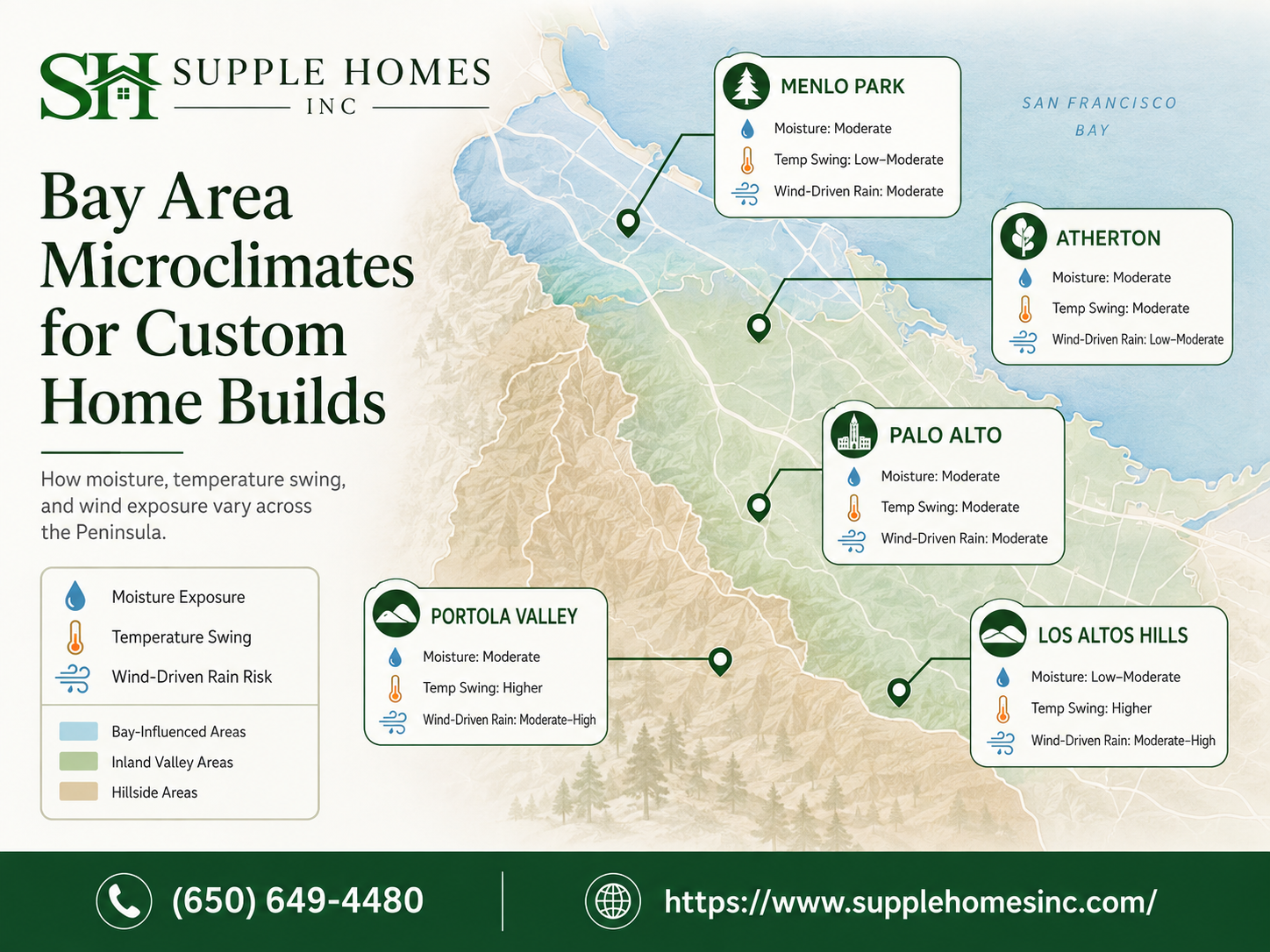
The Peninsula and South Bay are not uniform environments. Los Gatos, Palo Alto, Portola Valley, and Saratoga each sit within microclimates that can produce significant diurnal temperature swings, fog-driven moisture exposure, and seasonal wind patterns that stress envelope assemblies in ways that inland or coastal climates don't replicate exactly.
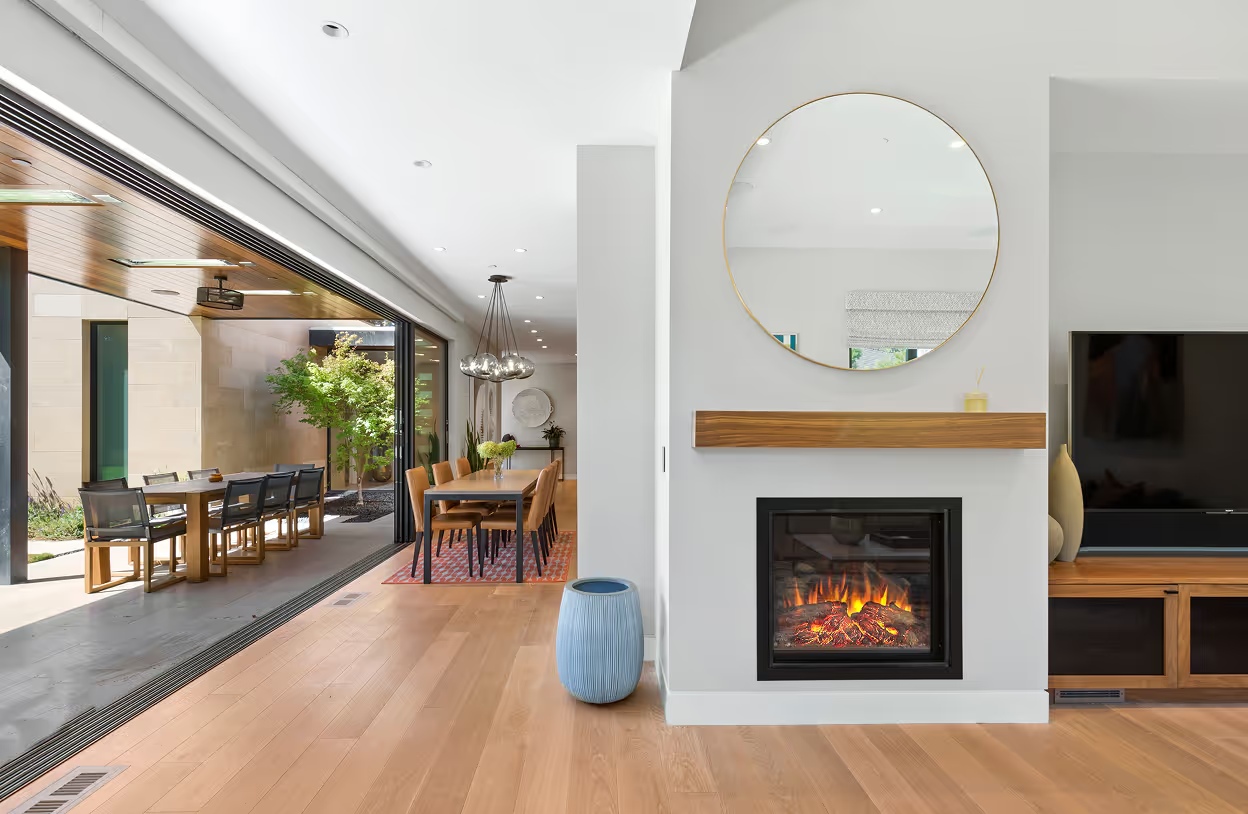
Homes with substantial outdoor-indoor transition spaces, which are common in the Bay Area given how clients prioritize that connection to their landscapes, introduce additional envelope complexity. Every glazed wall system, every covered outdoor kitchen, every sliding door pocket requires careful detailing to prevent water and air from migrating in ways that aren't obvious until they've already done damage.
The San Francisco Bay Area's combination of marine layer humidity, temperature variability, and seasonal wind-driven rain creates envelope exposure conditions that differ meaningfully from standard California climate zone assumptions, and can accelerate moisture-related degradation in assemblies that are not detailed with these local conditions in mind.
Understanding high-performance construction for Peninsula homes goes beyond choosing the right materials. It requires a builder who has worked in these specific microclimates and understands how they interact with the assemblies being built.
What Does High-Quality Envelope Execution Actually Look Like?
This is where the difference between builders becomes concrete. High-quality envelope execution is not a single action. It's a series of decisions and inspections built into the construction sequence from framing through enclosure.
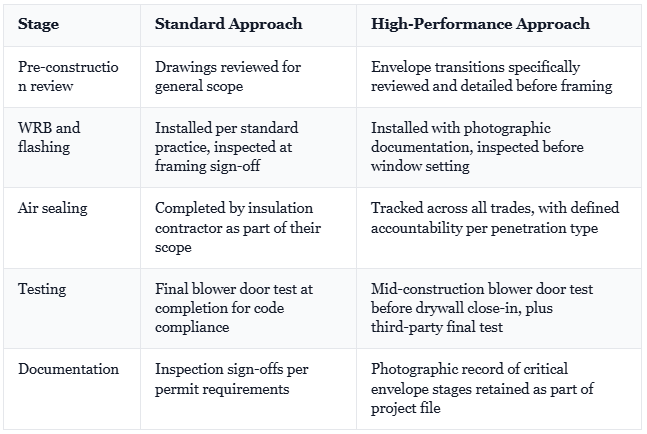
- Pre-construction envelope review: The builder reviews the architectural drawings specifically for envelope transitions and flags anything that needs additional detailing or coordination between trades before framing begins.
- Water-resistive barrier installation and inspection: The WRB is installed and inspected before windows and doors are set, with photographic documentation confirming continuity and proper lapping at transitions.
- Window and door flashing: Each opening is flashed according to a defined sequence, with sill pan flashing, head flashing, and integration with the WRB verified before the unit is set and before any cladding is applied.
- Air barrier continuity: The builder tracks air barrier continuity through all penetrations, including electrical, plumbing, HVAC, and structural connections, and ensures that each trade seals their own penetrations as part of their scope.
- Insulation inspection: Insulation installation is inspected before drywall, specifically looking for voids, compression, and gaps at framing transitions that would create thermal bridging.
- Blower door testing: A third-party blower door test is conducted before drywall close-in so that any air leakage can be identified and corrected while access is still available. A final test at completion provides the performance benchmark for the finished home.
- Roof-to-wall and deck-to-wall transitions: These are inspected specifically as a final envelope review before exterior cladding conceals them, with photographic documentation retained as part of the project record.
The Relationship Between Envelope Quality and the Homes You're Building
Does Your Architect Handle This?
A talented architect will specify envelope assemblies and details in the construction documents. That specification is necessary and important. But specification and execution are two entirely different things.
The builder and their trade partners are responsible for translating those drawings into what actually gets built. How carefully transitions are flashed, how consistently air barriers are maintained through penetrations, how thoughtfully sequencing is managed in the field, all of this is a function of the builder's craftsmanship and site supervision standards. Even perfectly designed envelope details can fail if they're not built with precision and inspected at the right stages.
The architect-builder relationship works best when both parties hold each other accountable. Choosing a builder who understands and respects envelope engineering is as important as the architectural design itself. For clients who want to understand how builders protect design intent in luxury renovation, the answer starts with this kind of field-level discipline.
How Do You Verify a Builder Is Actually Doing This Well?
The most reliable signal isn't a builder's sales conversation. It's the documentation and testing data from their previous projects.
- Ask to see blower door test results from completed homes, both mid-construction and at final completion.
- Request photographic documentation showing how window and door flashing, WRB transitions, and roof-to-wall details were executed and inspected on a recent project.
- Ask whether they use third-party inspectors or testing at key envelope stages, or whether inspection is handled exclusively in-house.
- Ask how they coordinate air barrier continuity across trades, and who is responsible for sealing penetrations created by each subcontractor.
- Ask what happens when an envelope detail in the architectural drawings is ambiguous or potentially problematic. A builder focused on quality will have a clear process for raising and resolving those issues before the work is done.
A builder who takes envelope quality seriously will welcome this level of scrutiny and have clear, specific answers. Deflection or vague reassurances are a meaningful signal about how they actually operate on site.
Blower door testing and thermal imaging inspections conducted during construction, rather than only at final completion, are considered best practice for verifying building envelope performance because they allow air leakage and insulation deficiencies to be corrected while the assembly is still accessible.
What Are the Common Mistakes Builders Make With Building Envelopes?
- Treating envelope details as a framing-stage concern only. Envelope quality requires attention at multiple construction stages, from framing through cladding installation, not a single inspection point.
- Delegating air sealing without clear trade accountability. When every subcontractor assumes another is sealing their penetrations, penetrations don't get sealed. Clear scope language and site supervision are the only reliable fixes.
- Substituting materials in the field without design review. An envelope assembly is designed as a system. Substituting one component, even with a "comparable" product, can break the system's performance in ways that aren't visible until failure.
- Skipping mid-construction testing. A final blower door test confirms what the envelope achieves. A mid-construction test done before drywall close-in is the only point where air leakage can actually be fixed.
- Underdetailing at custom transitions. Production home details don't transfer to custom geometries without adaptation. Complex roof intersections, large-format glazing systems, and mixed cladding conditions all require project-specific detailing that reflects how those specific assemblies interact.
How Envelope Performance Connects to Wellness and Daily Comfort
For clients building a home intended to be their permanent residence, envelope performance isn't just a construction technicality. It directly affects how the home feels to live in every day.
A well-executed envelope means consistent temperatures throughout the home without uncomfortable drafts near windows or exterior walls. It means acoustics that feel quiet and settled, because a continuous air barrier also attenuates sound transmission. It means the indoor air quality systems your home includes are actually working as designed, rather than fighting against uncontrolled air infiltration from outside. Families who are thinking about wellness-focused home design for comfort, air quality, and daily balance are often surprised to learn how much of that performance starts with envelope details they'll never see after move-in.
Building envelope airtightness is directly correlated with indoor air quality outcomes, because uncontrolled air infiltration bypasses mechanical ventilation filtration systems and introduces unfiltered outdoor air, pollutants, and moisture into the conditioned space.
Building Envelope Comparison: Standard Execution vs. High-Performance Execution
Frequently Asked Questions
What exactly is a building envelope, and why does it matter so much in a custom luxury home?
The building envelope refers to every component that separates the interior of your home from the outside environment: the foundation, walls, roof, windows, doors, and all the transitions between them. In a luxury custom home, the envelope is the single biggest determinant of long-term comfort, energy performance, and structural integrity. Poorly detailed envelope transitions are the most common source of moisture intrusion, air leakage, and thermal failure, problems that are invisible during a walkthrough but become expensive and disruptive to fix after move-in. For a home in the $3M to $8M range, the finishes are easy to see. It's the envelope details hidden behind those finishes that separate a home built to last from one that merely looks the part.
We've been through a difficult build before. How do we know a builder is actually executing envelope details correctly versus just telling us they are?
This is exactly the right question to ask, and a builder who takes envelope quality seriously will have a clear answer. Look for builders who conduct third-party blower door tests and thermal imaging inspections at key stages of construction, not just at final completion. Ask to see photos or documentation from previous projects showing how transitions, like where a roof meets a wall or where a window is flashed into a water-resistive barrier, are actually detailed and inspected. A builder committed to quality behind the walls will welcome this level of scrutiny and have the documentation to back it up. If a builder deflects or can't show you process evidence, that's a meaningful signal about how they operate.
Does the level of envelope detailing really affect energy performance in a California custom home, or is it just a construction technicality?
In California, energy performance is both a code requirement and a real quality-of-life issue, and the building envelope is the primary driver of both. Poor air sealing and improperly installed insulation can undermine even the most sophisticated HVAC or smart home systems, because you end up overworking expensive equipment to compensate for a leaky shell. Bay Area microclimates, particularly in areas like Los Gatos and Palo Alto, can create significant diurnal temperature swings and moisture exposure that a well-detailed envelope manages quietly and continuously. Beyond energy bills, proper envelope execution directly affects indoor air quality, acoustic performance, and the long-term durability of the structure, all of which matter in a home designed to be a family's permanent residence.
If we're hiring a high-end architect to design our home, aren't the envelope details already handled?
A talented architect will specify envelope assemblies and details in the construction documents, but specification and execution are two different things. The builder and their trade partners are responsible for translating those drawings into physical reality, and the quality of that translation is entirely a function of the builder's craftsmanship and site supervision standards. Even beautifully designed envelope details can fail if they're not built with precision and inspected at the right stages. The architect-builder relationship works best when both parties hold each other accountable, and choosing a builder who understands and respects envelope engineering is as important as the architectural design itself.
What are the most common building envelope failures in luxury custom homes, and how much can they cost to fix after the fact?
The most common failures involve water management at critical transitions: where roofs change planes, where windows and doors meet framing, where decks connect to exterior walls, and where different cladding materials meet. These failures are rarely visible at move-in. They typically surface two to seven years later as staining, rot, mold, or structural degradation concealed behind finished surfaces. Remediation in a luxury home is disproportionately expensive because it almost always requires removing and reinstalling premium finishes, custom millwork, or specialty cladding to access the underlying problem. Depending on the scope, envelope-related repairs in high-end homes can run from tens of thousands to several hundred thousand dollars, and that's before accounting for the disruption to a family living in the home. The entire point of rigorous envelope detailing during construction is to make those costs a non-issue for the life of the home.
The Bottom Line on Building Envelope Quality
Families building a forever home in the Bay Area are investing in far more than square footage and finishes. They're investing in a home that performs reliably for decades, that feels the way it was designed to feel on day one and on year twenty, and that doesn't surface expensive surprises after the builder has moved on.
The building envelope is where that promise is either kept or quietly broken. It's not visible in a finished home, which is exactly why the quality of the builder you choose matters more than almost any other decision you'll make in this process. If you're starting to think through what a custom build or large-scale renovation looks like for your family, understanding what to know before starting a large-scale luxury home renovation is a useful place to begin.
At Supple Homes Inc., the work that happens behind the walls is treated with the same level of precision and accountability as the finishes your family sees every day. If you'd like to talk through what a project looks like with a builder who approaches envelope quality this way, we're glad to have that conversation.