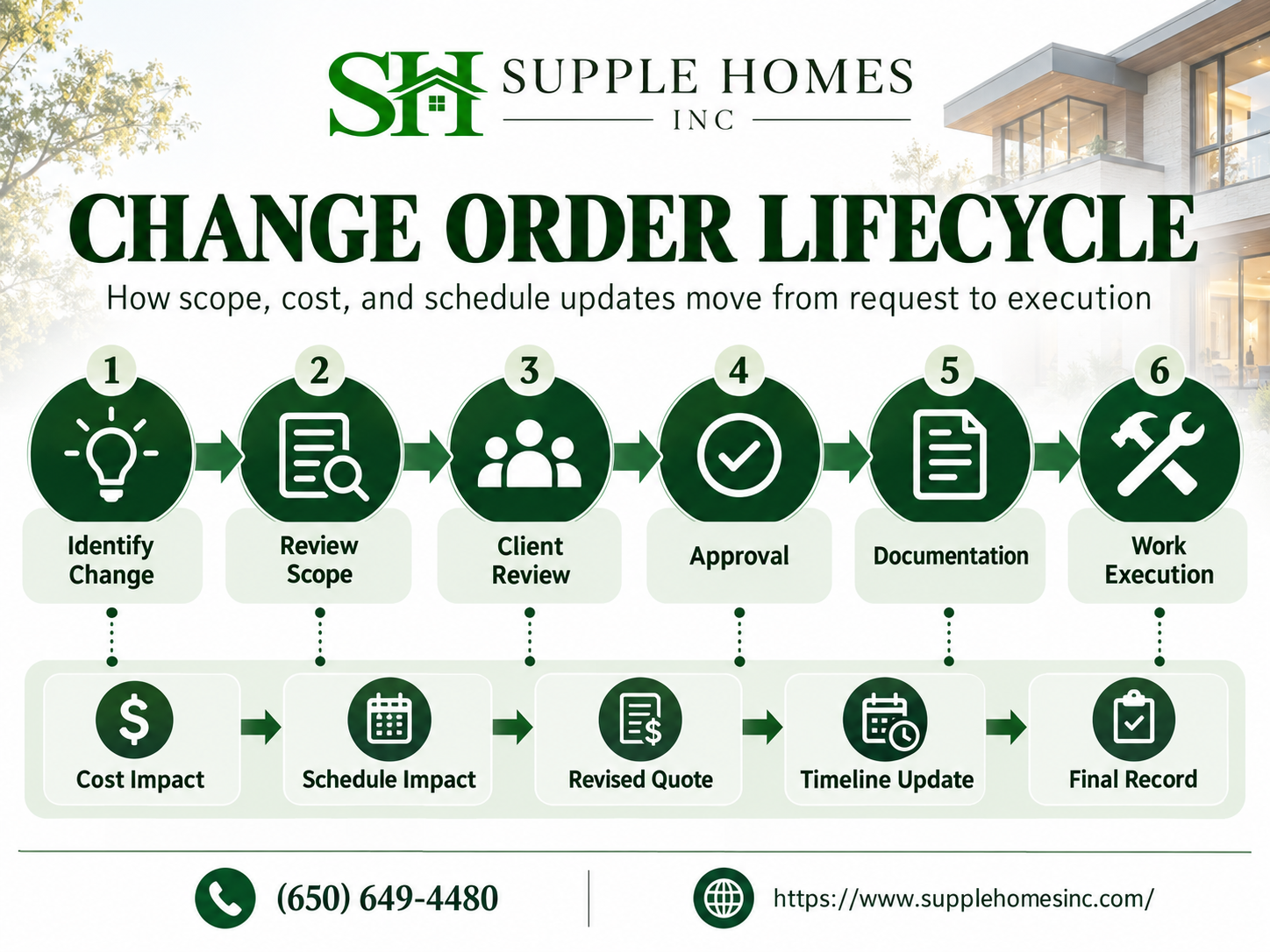
Before approving any change order on your custom home build, confirm that the document includes the full scope of work, an itemized cost breakdown, a revised timeline, and both parties' signatures. Change orders are a normal part of building a complex custom home, but how your builder handles them reveals whether you have a trusted advisor on your side or a contractor managing their own exposure. For Peninsula homeowners running $3M to $8M+ projects, a poorly documented change order can cost significantly more than the line item suggests once labor sequencing, subcontractor coordination, and permit revisions are factored in.
Key Takeaways
- Every change order should be fully documented and signed by both parties before any work on that change begins.
- The cost on a change order rarely reflects just materials. Labor re-sequencing and subcontractor adjustments often carry the larger financial impact.
- A builder who pushes back on a mid-build change is protecting your budget and schedule, not creating obstacles.
- Timeline impact must appear on every change order document alongside the cost adjustment, so you can make a fully informed decision.
- Investing in detailed pre-construction planning is the most reliable way to reduce the frequency and cost of change orders throughout the build.
Things You Must Know
1. The visible cost is rarely the total cost.
A change order's line item typically reflects materials and direct labor for the specific modification. What homeowners often miss are the downstream costs: a subcontractor who has to return to a completed phase, a permit revision that adds weeks, or a cascading effect on trades that were already sequenced and scheduled. On a build of 6,000 square feet or more, these secondary costs can match or exceed the primary one. Always ask your builder to walk through the full cost picture before approving.
2. The pre-construction phase determines how many change orders you'll face.
Change orders spike when design decisions are left open-ended at the start of a project. Homeowners who lock in finish selections, resolve structural details, and align with their architect before groundbreaking consistently see fewer mid-build surprises. This investment of time upfront is the most effective cost-control tool available, and any experienced builder should be guiding you through it systematically.
3. Verbal approvals do not protect you.
In a high-trust relationship with your builder, it can feel natural to approve a change in a walkthrough conversation and assume it will be handled. On a complex custom build, that approach creates real risk. Any change to scope, material, or timeline needs a signed change order before work proceeds. This protects you from misremembered conversations at close-out, and it protects your builder from scope-creep disputes that neither party intended.
What Is a Change Order on a Custom Home Build?
A change order is a formal written amendment to your original construction contract. It documents a modification to the agreed scope of work, the materials specified, or the project timeline, along with the cost adjustment that modification creates.
On a ground-up custom home, change orders happen for a range of reasons. A homeowner upgrades a countertop selection after cabinets are framed. An architect refines a roofline detail once the structure is visible. A site condition turns up during excavation that requires a foundation adjustment. These situations are not signs of a poorly managed project. They are the expected reality of building something complex and bespoke from the ground up.
The distinction between a well-run project and a frustrating one is not whether change orders occur. It is whether your builder surfaces them early, documents them completely, and treats each one as a transparent conversation rather than a line item that appears at the end.
Why Peninsula Homeowners Face a Different Risk Profile
Custom builds in Los Altos, Menlo Park, Palo Alto, and surrounding Peninsula communities carry a set of variables that amplify the downstream effects of change orders. Bay Area labor markets mean that trade schedules fill quickly, and a subcontractor who has to return to a phase they already completed is billing at a premium. Permit revision timelines through local building departments can add weeks that compound across a schedule. And at the $3M to $8M build level, even a seemingly minor scope change can carry a five-figure true cost once all factors are accounted for.
In the Bay Area construction market, labor costs for residential custom builds are among the highest in the country, with skilled trade rates significantly above national averages. According to a UC Berkeley Terner Center analysis, the San Francisco and San Jose metropolitan areas carried the two highest hourly median construction wages in California, reflecting a cost multiplier that applies to any rework triggered by a mid-build change order.
Homeowners who have worked with builders on previous projects, and arrived at the new build having been burned by surprise costs, are right to approach change orders with rigor. The solution is not to resist all changes. It is to have a builder who handles them with full transparency from the start.
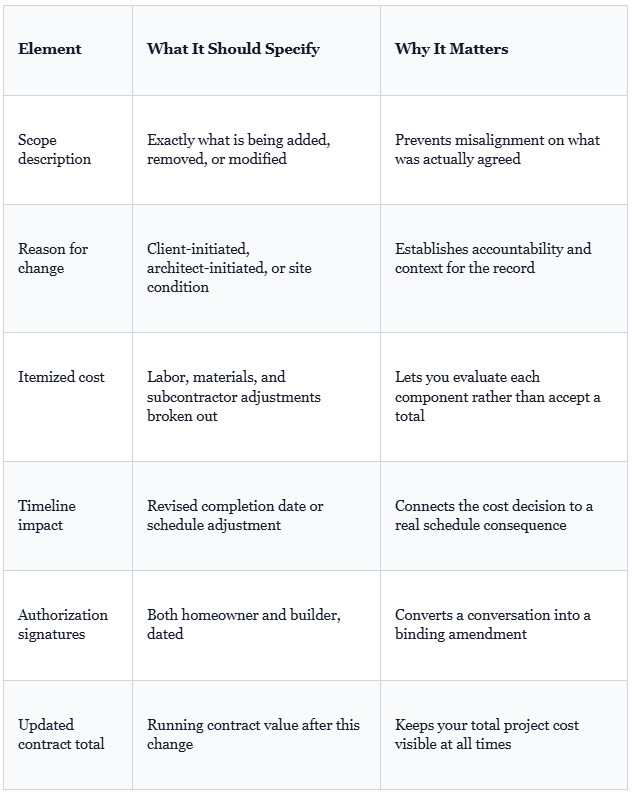
What a Complete Change Order Document Should Include
A change order that actually protects you covers six specific elements. If any of these are missing, ask for the document to be revised before signing.
How to Review a Change Order Before Approving It
When a change order lands in your inbox, this is the review sequence that protects your budget and your schedule.
- Confirm the scope is accurately described. Read the written description of the change and compare it to what you discussed. Ambiguous language like "upgrade finishes in master bath" is not sufficient. The specific materials, quantities, and areas affected should be named.
- Examine the cost itemization, not just the total. A change order that shows only a lump sum gives you no way to evaluate whether the pricing is reasonable. Ask for labor and materials broken out separately, and ask which subcontractors are affected.
- Ask about second-order effects. Some changes look contained but trigger work in phases already completed. If you are adding a feature that requires revisiting rough electrical, plumbing, or framing, the true cost should reflect that rework, not just the new addition.
- Review the timeline impact in writing. A cost adjustment without a schedule adjustment is often incomplete. Ask your builder directly whether this change affects the current completion target and by how many days or weeks.
- Weigh the timing against alternatives. Some changes are worth doing immediately. Others are better deferred to after close-out as a post-construction addition. Your builder should help you evaluate this honestly, not simply approve whatever keeps the project moving.
- Sign only when you are satisfied with all five points above. A builder who pressures you to sign quickly without fully answering your questions is a signal worth taking seriously.
Change Orders That Carry the Highest Cost Risk
Not all changes are equal. These categories consistently produce the largest cost and schedule surprises on Peninsula custom builds.
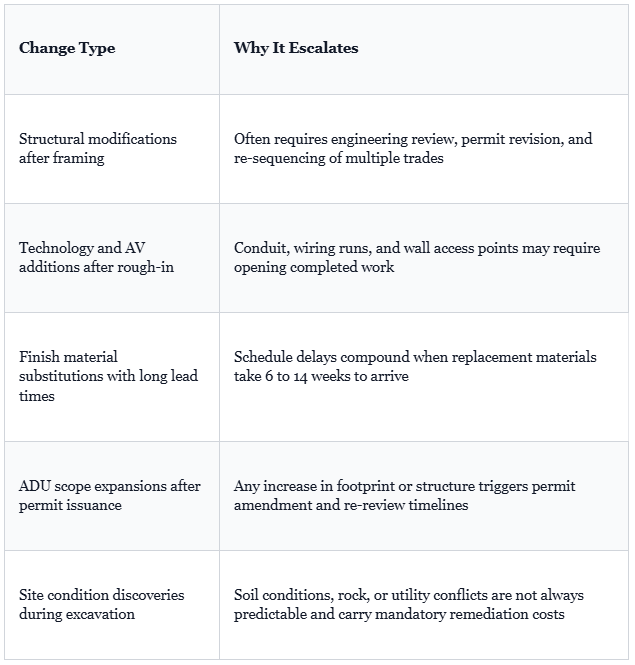
Changes initiated during the framing and mechanical rough-in phases consistently carry higher cost premiums than the same changes made during design development. As Autodesk's construction research notes, "changes that occur during actual construction will be significantly more expensive than in the design phase" — a dynamic that applies with particular force on Peninsula builds where labor remobilization costs compound every rework event.
Common Mistakes Homeowners Make with Change Orders
- Approving changes verbally without a written document. A conversation during a site walkthrough feels definitive, but verbal approvals are the most common source of close-out disputes on custom builds.
- Focusing only on the cost total rather than the itemization. A lump sum hides where the money is actually going and makes it impossible to evaluate the builder's pricing on individual components.
- Not asking about timeline effects. Some homeowners review the cost carefully and sign without asking whether the change adds days or weeks to completion, which has its own financial and personal cost.
- Initiating changes late in the build to avoid disrupting momentum. Waiting until work is nearly complete to request a modification almost always costs more than raising the same question earlier, when the project has more flexibility.
- Treating every change request as an adversarial negotiation. On a high-trust custom build, a change order is a collaborative tool. Approaching it with suspicion rather than curiosity tends to slow the process and strain the relationship without improving the outcome.
For homeowners building with Peninsula custom home services, the expectation should be that your builder raises potential changes proactively, before work proceeds, not after a decision has already been made on your behalf.
Frequently Asked Questions
What exactly is a change order in a custom home build, and why do they happen?
A change order is a formal written amendment to your original construction contract that documents any modification to the agreed scope, materials, or timeline, along with the associated cost adjustment. In a custom ground-up build, change orders arise for a range of reasons: a homeowner upgrades a finish selection mid-build, an architect refines a detail after framing is complete, or unforeseen site conditions require a structural adjustment. They are a normal part of building a custom home at the luxury level, especially on complex projects in the 4,000 to 11,000+ square foot range. A reputable builder treats every change order as a transparent, documented conversation, not a surprise line item surfaced at the end of the project.
How can I avoid unexpected costs from change orders when I've already set a firm budget?
The most effective approach is to invest heavily in the pre-construction phase: locking in detailed plans, specifying materials and finishes early, and working through design decisions before a shovel hits the ground. Builders who operate on a cost-plus or allowance-based pricing model can offer more transparency here, since every change is tracked against actual cost rather than a padded fixed-price buffer. Some change orders are unavoidable on custom builds. What matters is that your builder surfaces them early, explains the trade-offs clearly, and gives you real options rather than presenting a done-deal invoice. The builder's communication cadence, not just the contract structure, is the single biggest predictor of budget control. You can review what questions to ask a custom builder before signing to set this expectation from the start.
Should I be concerned if my builder pushes back on a change I want to make mid-construction?
No. A builder who pushes back thoughtfully is acting in your interest. On a high-complexity custom home, certain mid-build changes, such as relocating a load-bearing wall, adding a home theater after rough electrical is complete, or expanding an ADU footprint after permits are issued, carry cascading cost and schedule implications that are not obvious from the client's vantage point. A builder who says yes to every mid-build request without explaining downstream effects is the one to be cautious about. The right builder explains the real impact of the change, provides a transparent cost and timeline estimate, and helps you decide whether it's worth doing now, deferring, or rethinking entirely.
How do change orders affect the construction timeline on a custom home project?
Change orders that alter scope, materials, or sequencing can introduce schedule delays ranging from a few days to several weeks depending on where the project stands and what is being changed. Material substitutions late in the build may require re-ordering with longer lead times. Structural changes may require re-submittal to the building department for a permit revision. A well-run project includes a documented change order process that captures a revised schedule impact alongside the cost adjustment, so you can make an informed decision before approving. If your builder provides weekly progress updates and flags potential changes early, you are in a far better position to absorb or avoid delays.
What should a change order document actually include to protect both the homeowner and the builder?
A properly structured change order identifies the scope of work being added, removed, or modified; the reason for the change; the itemized cost impact covering labor, materials, and any subcontractor adjustments; the effect on the project timeline; and the signatures of both the homeowner and the builder before any work on that change begins. In Bay Area custom builds where projects routinely run $3M to $8M or more, even a seemingly minor change can carry a significant price tag once labor sequencing and subcontractor coordination are factored in. A signed change order protects you from verbal miscommunications and protects the builder from scope-creep disputes at close-out. If a builder is reluctant to put changes in writing before proceeding, treat that as a serious warning sign.
Working with a Builder Who Handles Change Orders the Right Way
The change order process is one of the clearest indicators of how a builder actually operates under pressure. It reveals whether their pricing model is transparent, whether their communication is proactive or reactive, and whether they see themselves as an advisor helping you make good decisions or a contractor managing their own risk.
Peninsula homeowners building at the custom level deserve a builder who raises potential changes before work proceeds, documents everything completely, and walks you through the real cost and timeline picture so you can decide with confidence. That is what a trusted advisor looks like in practice, not just in a sales conversation.
Supple Homes builds ground-up custom homes across Los Altos, Menlo Park, Palo Alto, Saratoga, Los Gatos, and surrounding Peninsula communities. You can explore completed custom home projects to see the quality and scope of work firsthand, or reach out directly to talk through your build and what to expect from the process.
Sources
- https://ternercenter.berkeley.edu/wp-content/uploads/pdfs/Hard_Construction_Costs_March_2020.pdf
- https://www.autodesk.com/blogs/construction/change-order/