The custom home selection timeline begins the moment your builder breaks ground on design, not the day framing starts. Windows, cabinetry, and fixtures each carry their own lead times and structural dependencies, and missing a single deadline can push your move-in date back by weeks or months. For Bay Area families building in communities like Los Gatos, Palo Alto, or Menlo Park, where permitting alone can span six months or longer, getting ahead of these decisions is the single most powerful way to protect your timeline and your budget.
Key Takeaways
- Window selections must be finalized before framing is complete because rough openings are sized to the unit you choose.
- Custom cabinetry typically carries a 12 to 16 week lead time and must be ordered well before drywall is scheduled.
- Plumbing fixtures drive rough-in locations, so those decisions need to land during framing, not after.
- Interior finishes like paint, hardware, and light fixtures carry lower risk and can be decided later in the process.
- Running selections in parallel with permitting is one of the most effective ways to compress the overall project schedule without cutting corners.
- A structured selection calendar, built by your builder from day one, is what separates a smooth build from a stressful one.
Things You Must Know
1. Lead Times Are Longer Than Most People Expect
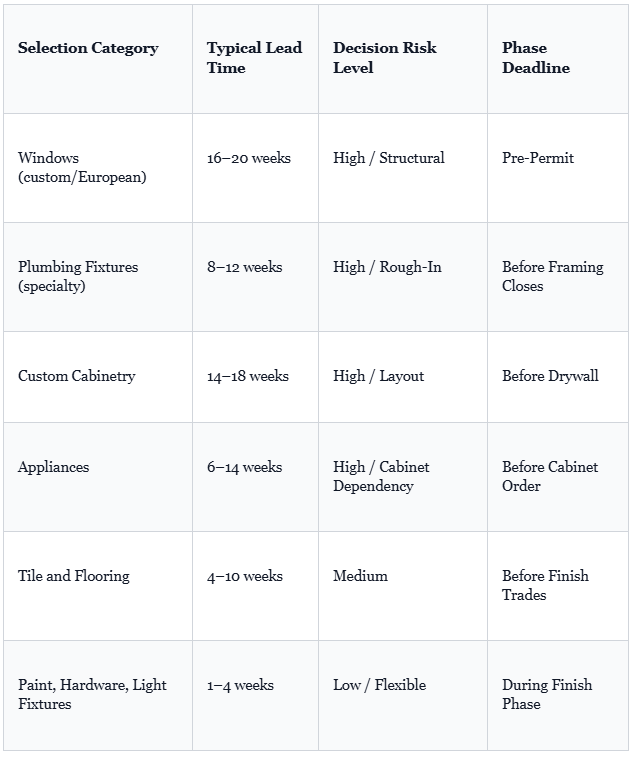
Custom windows from European manufacturers, semi-custom cabinet lines, and specialty stone can each take 12 to 20 weeks from order to delivery. On a ground-up custom build in the $3M to $8M range, several of these categories are running simultaneously. If any one of them is ordered late, the trade scheduled to install it may be off your job site and committed to another project by the time materials arrive. Your builder should give you a lead time sheet at the start of the project so you understand which categories carry the most schedule risk.
2. Some Decisions Are Irreversible Once Construction Passes That Phase
Choices tied to framing, plumbing rough-in, electrical conduit routing, and window openings cannot be changed after that phase closes without tearing into finished work. A client who decides to relocate a primary bath wet room after rough-in is complete faces a costly and time-consuming demolition sequence. The stakes are not the same across every category. A skilled builder will tell you exactly which decisions are locked once a phase passes and which ones still have flexibility, so you can allocate your attention accordingly.
3. Your Builder's Selection Management Process Matters as Much as Your Choices
Many clients who have been through a prior build describe the same frustration: they felt perpetually behind on decisions they didn't know were coming. That experience almost always reflects a builder who lacks a structured selection calendar, not a client who was unavailable. On a well-run project, you receive your upcoming deadlines weeks in advance, options are pre-vetted against your design direction, and the builder flags risk before it becomes a problem. If your builder cannot show you a selection schedule before construction begins, treat that as a red flag.
How the Selection Timeline Actually Works Phase by Phase
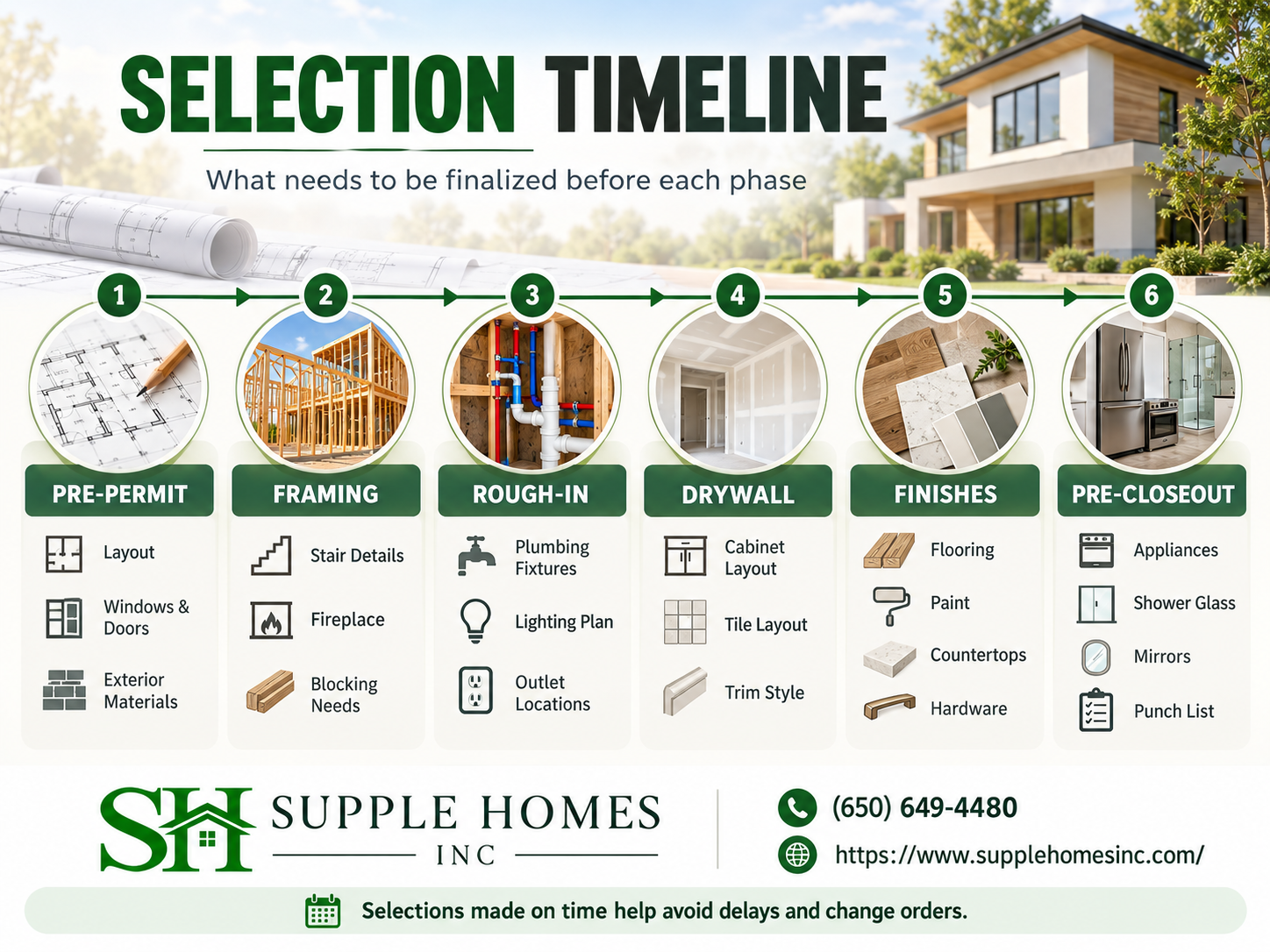
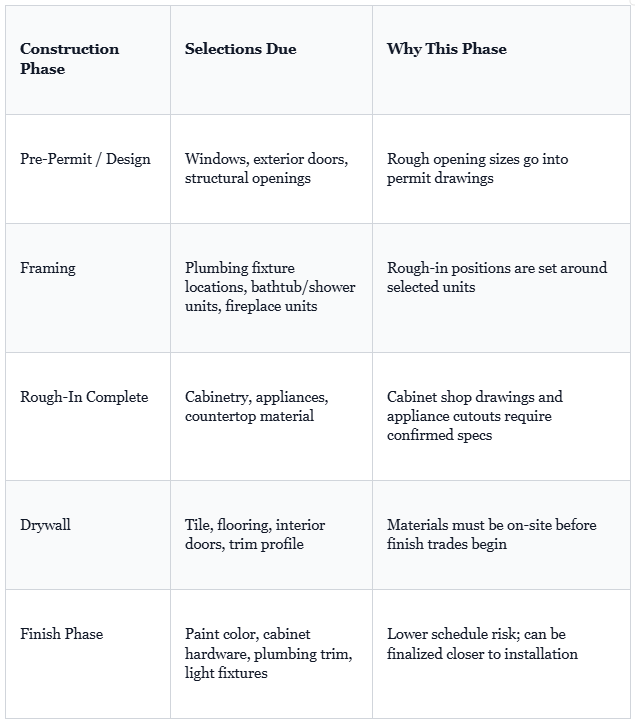
Custom home selections do not happen all at once, and they are not organized by room. They are organized by construction phase, because each phase physically closes the door on certain decisions. Understanding the sequence is what allows you to make confident choices on time rather than reactive ones under pressure.
Windows: The Selection That Drives Everything Else
Window selection is the earliest high-stakes decision in the entire process because the rough opening framed into your walls is sized specifically around the unit you choose. A different window manufacturer, series, or configuration means different rough opening dimensions, and changing that after framing is an expensive correction.
For Bay Area custom homes, the window category also involves meaningful performance decisions. California's Title 24 energy code sets specific requirements around U-factor and solar heat gain coefficients, and many clients in communities like Portola Valley or Woodside are choosing European-style tilt-and-turn units or thermally broken aluminum systems that carry 16 to 20 week lead times from specialty suppliers.
The practical implication: your window brand and series should be selected during design development, before permit drawings are submitted. Your builder should be pushing for this, not waiting for you to bring it up.
Cabinetry: The Most Complex Selection Category on Any Build
Custom and semi-custom cabinetry is the most logistically complex selection category in a luxury home build. It involves design drawings, shop drawings, revision cycles, production, and delivery, and every one of those steps takes time.
Cabinet selections also have downstream dependencies. Your appliance package must be confirmed before cabinet shop drawings are finalized because the refrigerator depth, range width, column refrigerator configuration, and dishwasher placement all affect cabinet sizing and panel requirements. A client who selects cabinetry before locking in appliances frequently faces revision fees and re-draws that could have been avoided.
The sequencing that works: confirm your appliance package first, then finalize cabinet design, then approve shop drawings for production. Your builder should own this sequence and enforce it, not leave it to you to manage.
Plumbing Fixtures: Decisions That Lock In Your Layout
Plumbing fixture selections determine where your rough-in goes, and rough-in locations are set during framing. A freestanding soaking tub, a floor-mounted tub filler, a wall-hung toilet, a steam shower unit, and a specific sink configuration all require precise stub-out locations that must be planned around the actual units you have chosen.
Luxury plumbing lines from brands common in high-end Bay Area builds often carry 8 to 12 week lead times on specialty items. The selection deadline for plumbing fixtures is earlier than most clients expect, and a good builder will surface it well before framing begins so you are not making a hasty choice to avoid a delay.
How to Run Selections and Permitting at the Same Time
Permitting in Bay Area jurisdictions can take six months or longer for a ground-up custom build. Waiting until permits are approved to begin selections adds that entire permitting window to your timeline unnecessarily. The two tracks can and should run in parallel, with one important distinction: structural and envelope selections must go into permit drawings, while interior finish selections can proceed independently.
- Finalize structural selections during design development. Windows, exterior doors, and any structural penetrations must be confirmed before permit drawings are submitted.
- Begin interior selections during the permitting period. Cabinetry, appliances, plumbing fixtures, tile, and flooring can all be selected while the permit review is underway.
- Order long-lead items before permits are approved. If your builder has confidence in the design and permit outcome, long-lead orders can be placed during the permitting period to eliminate that wait time from your post-permit schedule.
- Finalize finish-level selections during framing. Paint, hardware, trim details, and light fixtures can be decided while structural and rough-in work is progressing.
- Confirm all selections before their corresponding trade phase begins. Your builder's selection schedule should map every decision to the last possible date before that trade mobilizes.
Builders who manage this overlap well can save two to four months on a typical Bay Area custom build. For families coordinating school enrollment, lease expirations, or moving aging parents into an ADU on the SF Peninsula, that compression matters.
Common Mistakes That Push Timelines Back
- Selecting cabinetry before the appliance package is confirmed, which triggers shop drawing revisions and reorders.
- Treating window selection as a finish-phase decision rather than a pre-permit structural one.
- Choosing a plumbing fixture line without confirming lead times, then discovering the item is backordered after rough-in is set for a different configuration.
- Assuming that any decision can be changed after construction passes that phase, without understanding the cost of rework.
- Working with a builder who does not proactively surface upcoming deadlines, leaving the homeowner to track the schedule themselves.
- Starting selections without a pre-vetted shortlist of options aligned to your design direction, which turns every decision into a research project.
What a Well-Managed Selection Process Looks Like
The difference between a build that finishes on schedule and one that runs three months long often comes down to how selections are managed, not how fast trades work. A well-run process gives you a master selection calendar on day one, maps every decision to a deadline, and provides pre-vetted options that reflect your design direction and lifestyle priorities so you are making focused decisions rather than open-ended ones.
For executives and dual-income households managing demanding careers, this structure is what makes it possible to stay engaged in the build without being consumed by it. You review options, make decisions on a known schedule, and trust your builder to hold the timeline accountable between those touchpoints. You can explore custom home services on the SF Peninsula to understand how a structured approach applies across the full scope of a ground-up build.
Frequently Asked Questions
How long does the selection process typically take for a custom home build in the Bay Area?
The selection process for a custom home in the Bay Area generally spans four to six months before construction begins, and rushing this phase is one of the most common causes of delays and cost overruns later. For homes in the $3M to $8M range, selections cover everything from structural finishes and cabinetry to smart home systems, appliances, and specialty materials that often carry long lead times. Experienced builders front-load this process intentionally, running selections in parallel with permitting so that decisions are finalized before trades need them on-site. At Supple Homes, a structured selection calendar is built into every project so busy executives and dual-income households can make decisions on a predictable schedule without being overwhelmed.
What happens if we fall behind on selections? Will it delay our construction timeline?
Yes, and the downstream effect is often larger than homeowners expect. If a custom tile, cabinet line, or piece of millwork carries a 12 to 16 week lead time and the decision is made late, the framing crew may be ready while the materials are still in transit. On a high-end custom build, even a two-week hold can cascade into a six to eight week schedule shift as subcontractors reschedule and sequencing is disrupted. A builder who proactively surfaces upcoming decision deadlines and pushes back when timelines are at risk is far more valuable than one who simply accommodates delays without flagging the consequences.
We've worked with builders before and felt constantly behind on decisions we didn't know were coming. How do we avoid that this time?
This frustration almost always comes down to the builder's selection management process, not the client's availability. A well-run custom home project uses a master selection schedule that maps every decision to the date it must be finalized, giving homeowners weeks of lead time rather than days. The best builders act as a trusted advisor throughout this process, recommending vetted options, narrowing the field based on your lifestyle priorities, and flagging when a choice is approaching its deadline. When communication is proactive and the builder takes ownership of the timeline, clients managing demanding careers can stay engaged without being consumed by the process. You can read through questions to ask a custom home builder before you commit to make sure selection management is part of the conversation.
Can selections and permitting happen at the same time to shorten the overall project timeline?
Yes, and running these two tracks in parallel is a hallmark of experienced luxury custom builders. Permitting in Bay Area jurisdictions like Los Gatos and Palo Alto can take six months or longer depending on the scope and municipality, and waiting until permits are approved to begin selections adds unnecessary time to an already long process. Structural and envelope decisions need to be locked in for permit submission, but interior finishes, fixtures, appliance packages, and smart home systems can be selected concurrently. Builders who orchestrate this overlap effectively can shave months off the total timeline without compressing any individual phase, which matters significantly when families are coordinating school calendars, lease expirations, or the timing of aging parents moving in.
How do we know which selections are high-stakes decisions versus ones we can change later?
Decisions tied to framing, plumbing rough-in, electrical conduit routing, and window openings are effectively irreversible once construction passes those stages, and changing them later means costly demolition and rework. Finish-level decisions like paint color, cabinet hardware, or light fixture styles carry much lower risk and can sometimes be adjusted later with minimal impact. A skilled builder will explicitly categorize selections by their timeline sensitivity at the start of the project, so you know where to focus your decision-making energy and where you have room to be more deliberate.
Ready to Build on a Schedule You Can Trust?
A well-managed custom home selection timeline is not just a convenience. It is what keeps a $4M or $6M project on schedule, protects your budget from costly rework, and gives your family a move-in date you can actually plan around.
Supple Homes Inc. builds a structured selection calendar into every project from day one. If you are planning a ground-up custom home in Los Gatos, Palo Alto, Menlo Park, or the surrounding Bay Area communities, the best time to talk through your timeline is before your architect submits for permits, not after. Reach out to Supple Homes to start that conversation.