Building on a sloped lot in the San Francisco Peninsula requires careful geotechnical analysis, engineered foundations, and site-specific drainage planning before any construction begins. Costs and complexity are higher than flat-lot builds, but with the right team, hillside properties can yield exceptional homes with long-term value. The key is understanding the full scope of challenges before breaking ground.
Hillside lots are everywhere across the Peninsula, from the ridgelines above Woodside and Portola Valley to the terraced neighborhoods of San Mateo and Belmont. They offer sweeping views and privacy that flat lots rarely match. But building on them is a fundamentally different process, and homeowners who underestimate that difference often face costly surprises mid-project. If you're considering a sloped site, this guide covers what you actually need to know before committing.
Key Takeaways
- Sloped lots on the Peninsula require geotechnical investigation before design can begin in earnest.
- Foundation type, retaining wall design, and drainage strategy are all slope-dependent decisions that affect overall cost significantly.
- Grading permits, erosion control requirements, and hillside-specific building codes apply in most Peninsula jurisdictions.
- Soil conditions vary dramatically across the region, and what worked on one hillside parcel may not work a mile away.
- Experienced local contractors and engineers familiar with Peninsula geology are not optional on these projects.
- The construction timeline on a sloped lot is typically longer than a comparable flat-lot build due to additional permitting and site work phases.
Things You Must Know
1. A Geotechnical Report Is Not Optional
Many buyers assume that a sloped lot is buildable simply because it's for sale. That assumption can be expensive. A geotechnical (soils) report is required by most Peninsula jurisdictions before a building permit is issued on a hillside parcel, and it often shapes every major structural decision that follows. The report assesses soil bearing capacity, slope stability, seismic risk, and groundwater presence. Without it, your architect and structural engineer are essentially working in the dark.
2. Retaining Walls Are a Structural Investment, Not a Finishing Detail
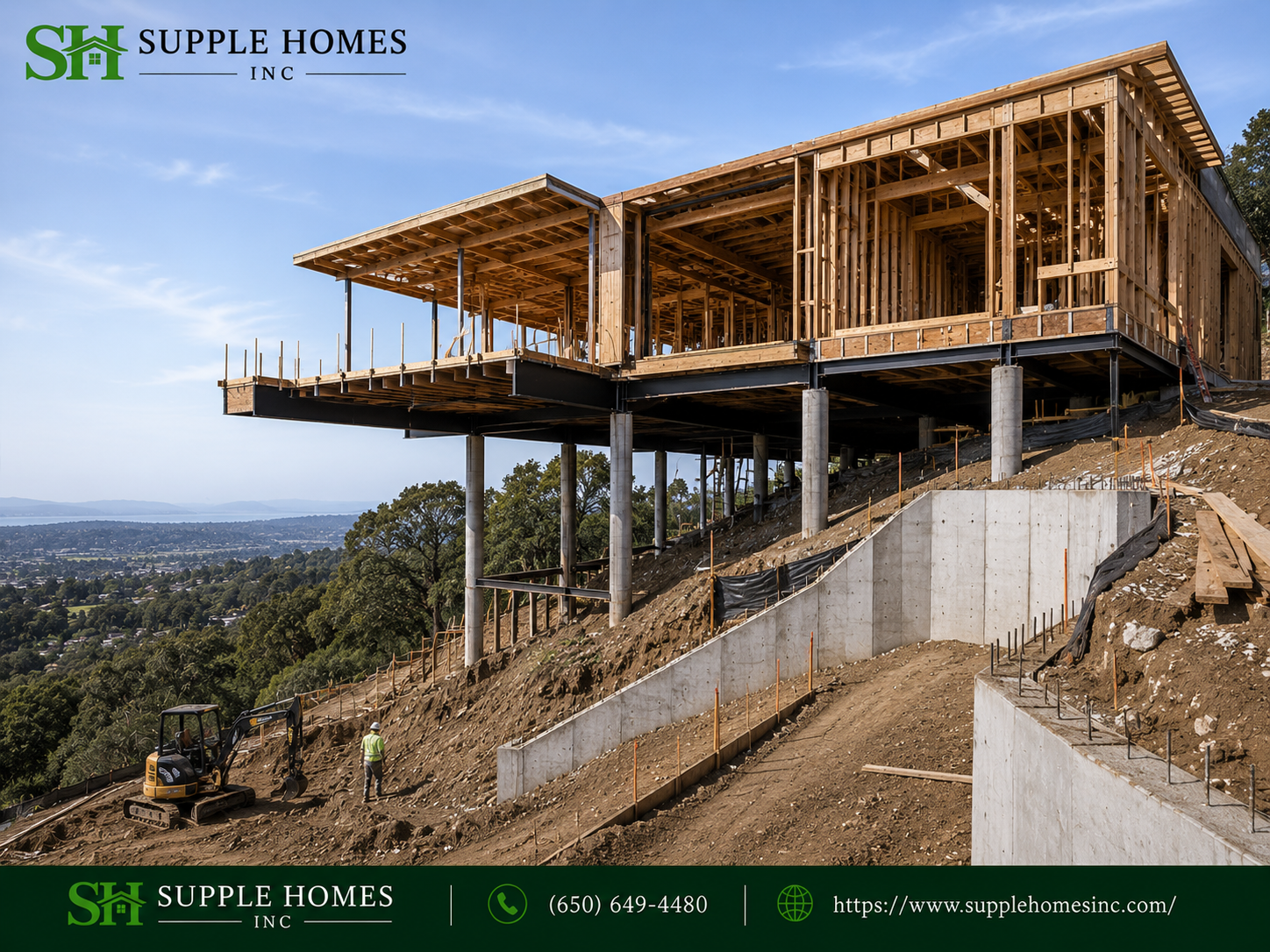
On steep lots, retaining walls do heavy engineering work. They manage lateral earth pressure, prevent slope movement, and support graded terraces that allow construction to proceed. These aren't decorative garden walls. Depending on height and soil conditions, they may require engineered drawings, special inspections, and drainage systems behind them. Treating them as an afterthought in the budget is one of the most common and costly mistakes on hillside projects.
3. Water Moves Differently on Hillside Sites
Drainage planning on a flat lot is relatively straightforward. On a slope, water accelerates, concentrates, and can undermine foundations or cause erosion if not actively redirected. Grading plans must account for both surface runoff and subsurface water movement. In the Peninsula's wet winters, a poorly drained hillside site can experience significant damage before the home is even framed. Your drainage strategy should be engineered, not improvised.

What Makes the San Francisco Peninsula Uniquely Challenging for Hillside Construction?
The Peninsula sits along the western edge of the Bay Area, where the Santa Cruz Mountains meet a densely developed suburban landscape. The geology here is genuinely complex. You'll find expansive clay soils in some areas, serpentinite and bedrock closer to the surface in others, and active fault zones running through the region. Rainfall patterns are highly seasonal, with dry summers followed by concentrated precipitation from November through April that saturates hillside soils and raises landslide risk.
Municipalities across the Peninsula, including Hillsborough, Atherton, Los Altos Hills, and Portola Valley, have developed their own hillside development ordinances on top of California state building code requirements. Some jurisdictions impose maximum lot coverage restrictions, grading limits measured in cubic yards, and view corridor protections that constrain where and how you can build. Understanding the specific rules of your municipality before purchasing a sloped lot can prevent significant frustration later.
The San Francisco Bay Area is one of the most seismically active regions in the United States. Hillside sites amplify seismic risk because sloped ground is more prone to soil liquefaction and landslide-triggering ground motion than stable flat parcels, making seismic considerations a central part of any hillside engineering plan.
The Site Planning Process: Where Hillside Projects Begin
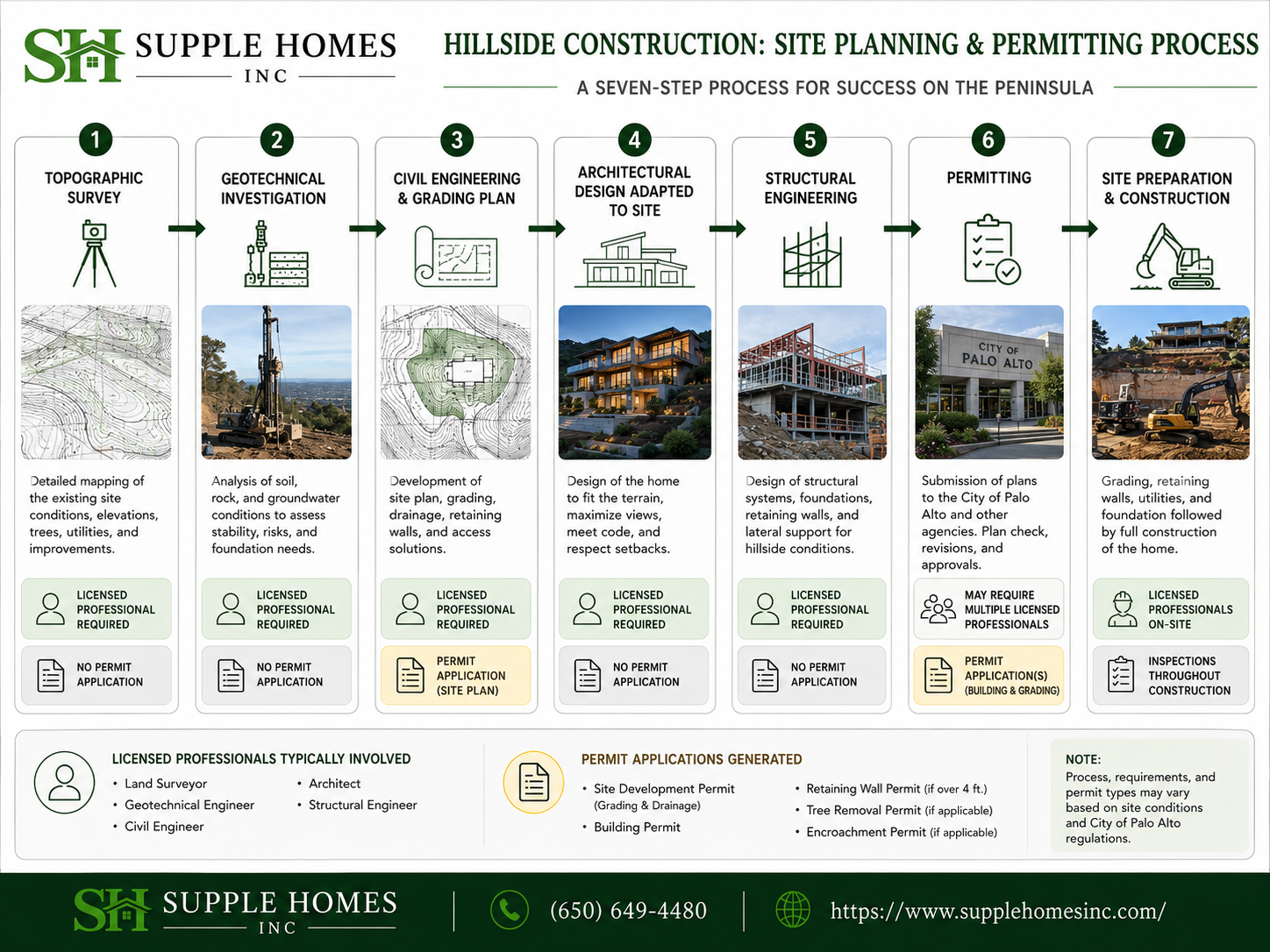
Effective site planning on a sloped lot starts well before architectural design. The sequence matters, and skipping steps early almost always creates problems downstream.
- Topographic Survey: A licensed surveyor produces a precise map of existing grades, trees, drainage patterns, and property boundaries. This becomes the base layer for all design and engineering work.
- Geotechnical Investigation: A geotechnical engineer performs soil borings or test pits, assesses slope stability, and delivers a report with foundation recommendations and grading constraints. This report is submitted with your building permit application.
- Civil Engineering and Grading Plan: A civil engineer designs the grading, drainage, and erosion control plan. This must comply with the local municipality's grading ordinance and, in many Peninsula cities, requires a separate grading permit before building permits are issued.
- Architectural Design Adapted to Site: With the geotech report and grading plan in hand, your architect designs the home's footprint and massing to work with the slope rather than against it. Split-level layouts, stepped foundations, and cantilevered sections are all common responses to steep terrain.
- Structural Engineering: The structural engineer specifies foundation type, retaining wall systems, and the lateral force-resisting system for both wind and seismic loads. On hillside sites, this scope is substantially larger than on flat lots.
- Permitting: Applications go to the local building department and, depending on the municipality, may also require review by a planning commission or design review board. Hillside projects frequently require longer review cycles.
- Site Preparation and Construction: Grading, utility trenching, retaining wall installation, and foundation work happen before vertical framing begins. These phases are more labor-intensive and time-consuming on sloped sites.
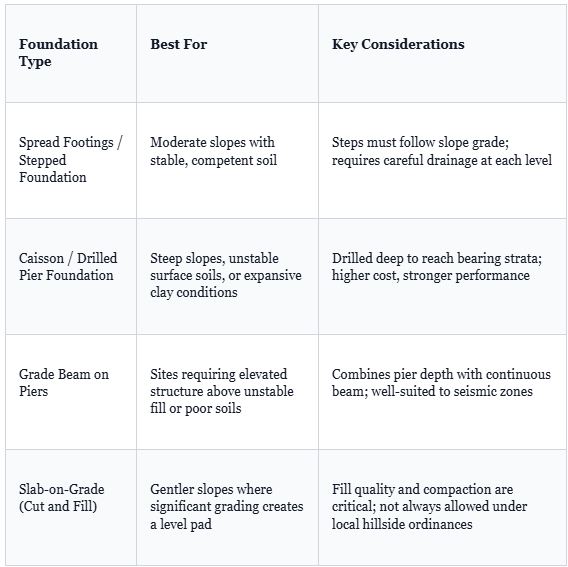
Foundation Options for Sloped Lots
Foundation selection on a hillside is driven by soil conditions, slope angle, and load requirements. There's no universal answer, and the geotechnical report is what narrows the options for your specific site.
If you're planning a custom home on the Peninsula, understanding the full custom home building process from planning to final walkthrough helps set realistic expectations for how site-specific engineering fits into the larger project timeline.
Retaining Walls: Engineering, Not Aesthetics
On steeply sloped lots, retaining walls are often one of the largest line items in the site work budget. Their purpose is structural: holding back soil so that graded terraces remain stable and don't shift over time or during seismic events.
In most Peninsula jurisdictions, retaining walls above a certain height (commonly 4 feet of exposed face) require engineered drawings stamped by a licensed structural or geotechnical engineer, a separate permit, and special inspections during construction. Some cities require planning review for walls visible from the street, regardless of height.
Retaining wall systems must also include drainage. Hydrostatic pressure from water trapped behind an improperly drained wall is a leading cause of wall failure. Gravel backfill, perforated drain pipe, and weep holes are standard components of an engineered retaining wall assembly, not optional upgrades.
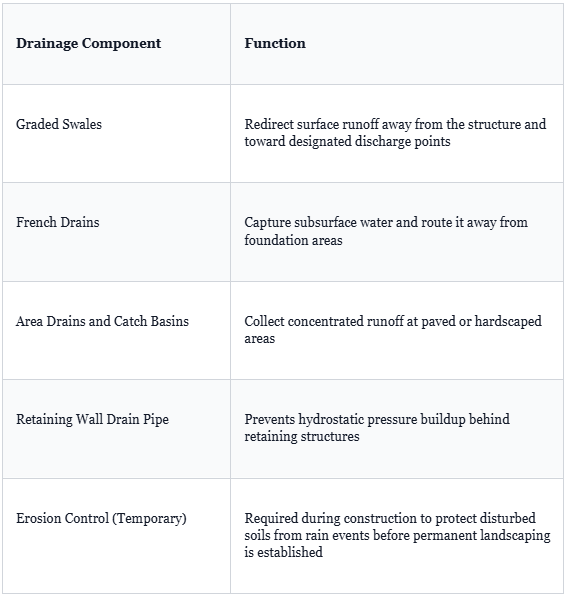
Water Management and Drainage Planning
Few issues cause more long-term problems on hillside sites than inadequate drainage. Surface water must be captured, directed, and discharged in a controlled way that doesn't erode slopes, saturate foundations, or push water onto neighboring properties.
Homeowners planning a hillside build on the Peninsula should review what to know before building a custom home on the San Francisco Peninsula for a broader picture of the pre-construction preparation involved.
Common Mistakes Homeowners Make on Sloped Lot Projects
- Underbudgeting for site work: Grading, retaining walls, drainage systems, and utility trenching on sloped lots routinely cost more than buyers anticipate. Site work expenses should be understood in detail before finalizing a lot purchase or project budget.
- Skipping the geotechnical report early: Some buyers delay the geotech investigation to save money during due diligence. This often leads to design revisions after purchase when soil conditions don't match assumptions.
- Designing before understanding grading limits: If your municipality caps the cubic yards of soil that can be moved, the architectural design must reflect that constraint from the start, not after permits are submitted.
- Treating drainage as an afterthought: Drainage infrastructure needs to be part of the civil engineering scope from day one, not something addressed in landscaping at the end of the project.
- Hiring contractors without hillside experience: Sloped-lot construction requires specific knowledge of earthwork, shoring, and sequencing that flat-lot experience doesn't automatically provide.
- Assuming neighboring lots set a precedent: Soil conditions, slope angle, and drainage patterns can change significantly even within a short distance. What was approved or built next door may not reflect what's required on your parcel.
Cost Considerations for Hillside Construction
Building on a sloped lot typically adds 15% to 30% or more to total construction costs compared to an equivalent home on a flat parcel, depending on slope severity, soil conditions, and local permitting requirements. The additional cost is concentrated in site work, foundation, and structural engineering line items rather than in the finished living space itself.
The factors that drive the cost differential most significantly are slope angle, soil bearing capacity, and distance from utility connections. Gentle slopes with stable soils and accessible utilities will sit at the lower end of the range. Steep lots with expansive clay, limited access for equipment, and deep utility trenching can push well beyond it. Getting detailed cost estimates from a contractor with Peninsula hillside experience, rather than relying on regional averages, is the only reliable way to budget accurately.
For homeowners interested in what the full investment can yield, learning more about building a high-performance luxury home on the San Francisco Peninsula offers useful perspective on how site complexity translates into long-term value.
Frequently Asked Questions
Do I need a special geotechnical report for a sloped lot on the Peninsula?
Yes, in most Peninsula jurisdictions, a geotechnical report is a required submittal for building permits on hillside parcels. The report must be prepared by a licensed geotechnical engineer and typically includes soil classification, slope stability analysis, foundation recommendations, and grading constraints. Even in jurisdictions where it isn't technically required by code, no competent structural engineer will design a hillside foundation without one. Skipping this step is not a cost savings; it's a liability.
What type of foundation is typically required on a sloped lot?
Foundation type depends on slope angle, soil conditions, and the structural loads involved. Drilled caisson (pier) foundations are common on steep Peninsula hillsides because they bypass unstable surface soils and anchor into competent bearing material below. Stepped spread footings can work on gentler slopes with stable soils. Your geotechnical engineer's report will specify what's appropriate for your site, and the structural engineer will design accordingly. There's no universal answer that applies across the Peninsula.
Why is water management so important on hillside construction sites?
Hillsides concentrate and accelerate water movement. Without a designed drainage system, surface runoff can erode disturbed soils during construction, saturate foundation areas, and create hydrostatic pressure against retaining walls. The Peninsula's wet winters mean that construction phases happening between November and April require active erosion control measures. Long-term, a drainage system that isn't properly engineered can cause slope movement, foundation settlement, or retaining wall failure years after the home is completed.
Will building on a sloped lot cost more than building on a flat lot?
In almost every case, yes. The cost premium comes from additional site work (grading, retaining walls, drainage), more complex foundation systems, longer permitting timelines, and the need for specialized engineering services beyond what a standard flat-lot build requires. The exact premium depends on how steep the slope is, what the soil conditions are, and what the local jurisdiction requires. A contractor experienced with hillside projects on the Peninsula can give you a realistic estimate once a geotechnical report and preliminary plans are in hand.
How are retaining walls regulated in Peninsula cities?
Regulation varies by municipality, but most Peninsula cities require building permits for retaining walls above a threshold height, commonly measured at the exposed face. Walls above that threshold typically require engineered drawings from a licensed structural or geotechnical engineer and may require special inspections during construction. Some jurisdictions also require planning review for walls visible from public streets or neighboring properties. Checking with your local building department before finalizing your grading plan is essential, as non-compliant walls can trigger stop-work orders or removal requirements.
Building on a Sloped Lot Requires the Right Team from Day One
Hillside construction on the San Francisco Peninsula is rewarding when it's done right. The sites often yield exceptional homes with views, privacy, and a connection to the natural landscape that flat lots simply can't offer. But the complexity is real, and the stakes of getting early decisions wrong are high. Soil conditions, slope stability, drainage, and local regulations all need to be understood and addressed before design commitments are made.
Working with a builder who has direct experience on Peninsula hillside sites isn't a luxury. It's how you avoid the costly surprises that derail projects when teams unfamiliar with this terrain take on work they're not equipped to handle.
If you're evaluating a sloped lot or beginning to plan a hillside home on the San Francisco Peninsula, Supple Homes Inc. can help you understand what your site requires and what the path forward looks like. Reach out at (650) 649-4480 to start the conversation.