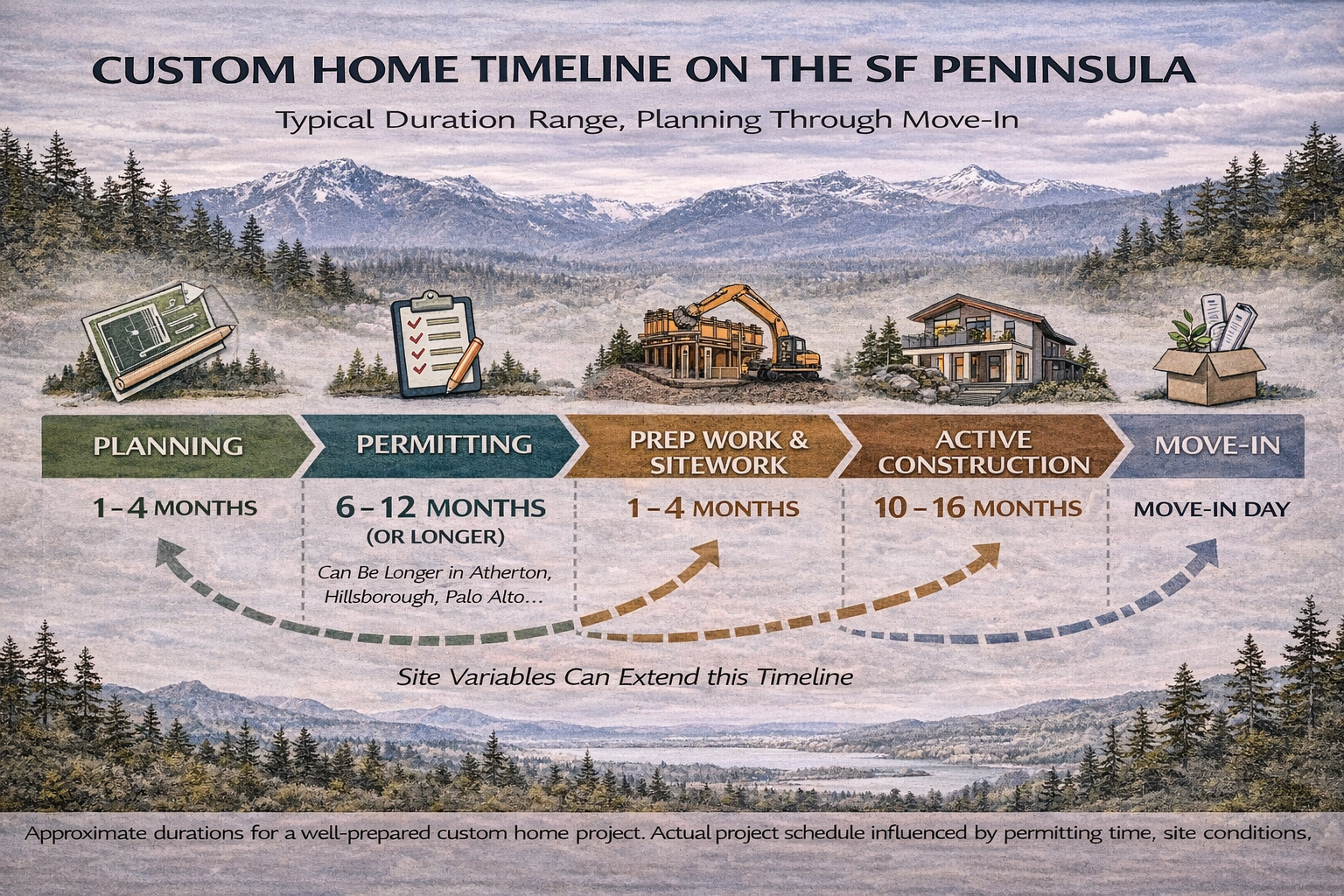
Building a custom home on the San Francisco Peninsula typically takes 18 to 36 months from initial planning through final occupancy, with permitting alone often consuming 6 to 12 months depending on the city. Local geology, hillside lot conditions, design complexity, and strict municipal review processes all extend timelines well beyond national averages.
If you've been told "about a year," you've been given an incomplete picture. Peninsula homebuilding operates inside one of the most regulated, geologically complex, and design-intensive environments in the country. Understanding the real timeline before you commit to a lot or a builder can be the difference between a smooth process and a costly, stressful surprise.
Key Takeaways
- Most custom homes on the San Francisco Peninsula take 18 to 36 months from planning to move-in, not counting land acquisition.
- Permitting is the single biggest wildcard, often taking 6 to 12 months or longer in cities like Atherton, Hillsborough, and Palo Alto.
- Active construction typically runs 120 to 16 months for a well-prepared project, assuming no major change orders or material delays.
- Site conditions, including hillside lots, expansive soils, and proximity to fire hazard zones, can add months before a single foundation is poured.
- Working with an experienced local builder who knows Peninsula municipalities reduces permitting friction and timeline risk significantly.
- Design finalization before permit submission is one of the most effective ways to avoid costly delays mid-project.
Why the Peninsula Is Different From Every Other Custom Home Market
The San Francisco Peninsula is not a typical custom home market. Between Daly City in the north and Palo Alto in the south, you're navigating dozens of independent municipalities, each with its own planning commission, architectural review board, and permitting staff. What's approved in Menlo Park in four months might take eight in Portola Valley.
The physical landscape adds another layer. Peninsula lots are frequently sloped, with unstable or expansive soils requiring geotechnical reports before design can even begin. Fire Hazard Severity Zones cover significant portions of the hillside communities, triggering additional building standards, setback requirements, and materials specifications that take time to engineer properly.
The national average timeline for a custom home build runs approximately 12 to 18 months according to industry surveys, but California's coastal municipalities routinely exceed that figure due to CEQA reviews, design oversight requirements, and limited permitting staff capacity. The Bay Area, and the Peninsula specifically, consistently ranks among the slowest permitting environments in the state.
Breaking Down the Full Timeline: Phase by Phase
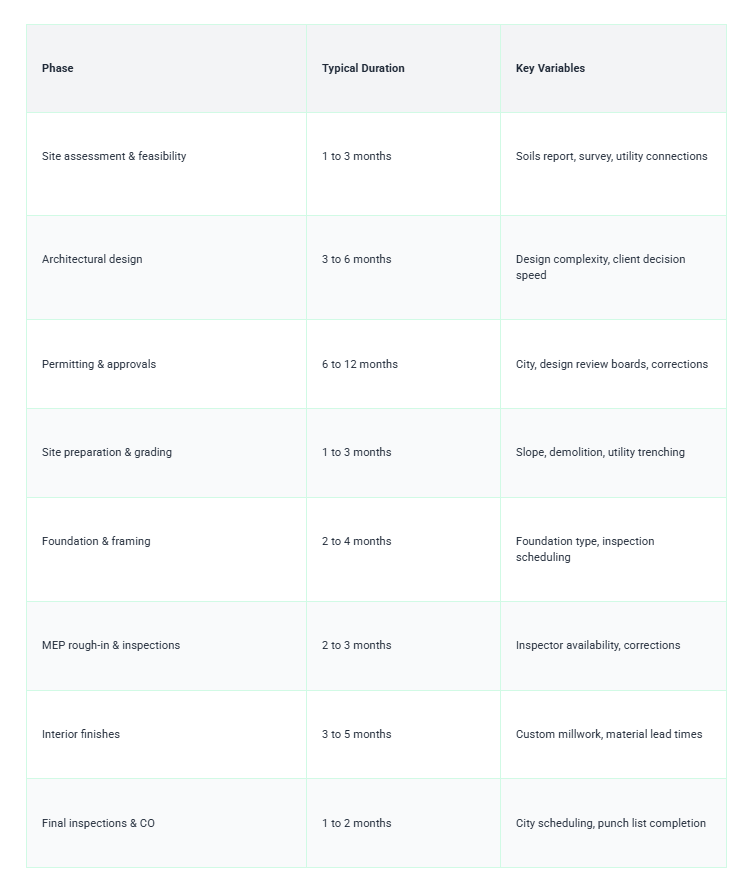
The best way to plan is to treat every phase independently. Lumping everything together produces false confidence. Here's how the time actually distributes across a typical Peninsula custom home project.
The Permitting Process: Where Most Projects Stall
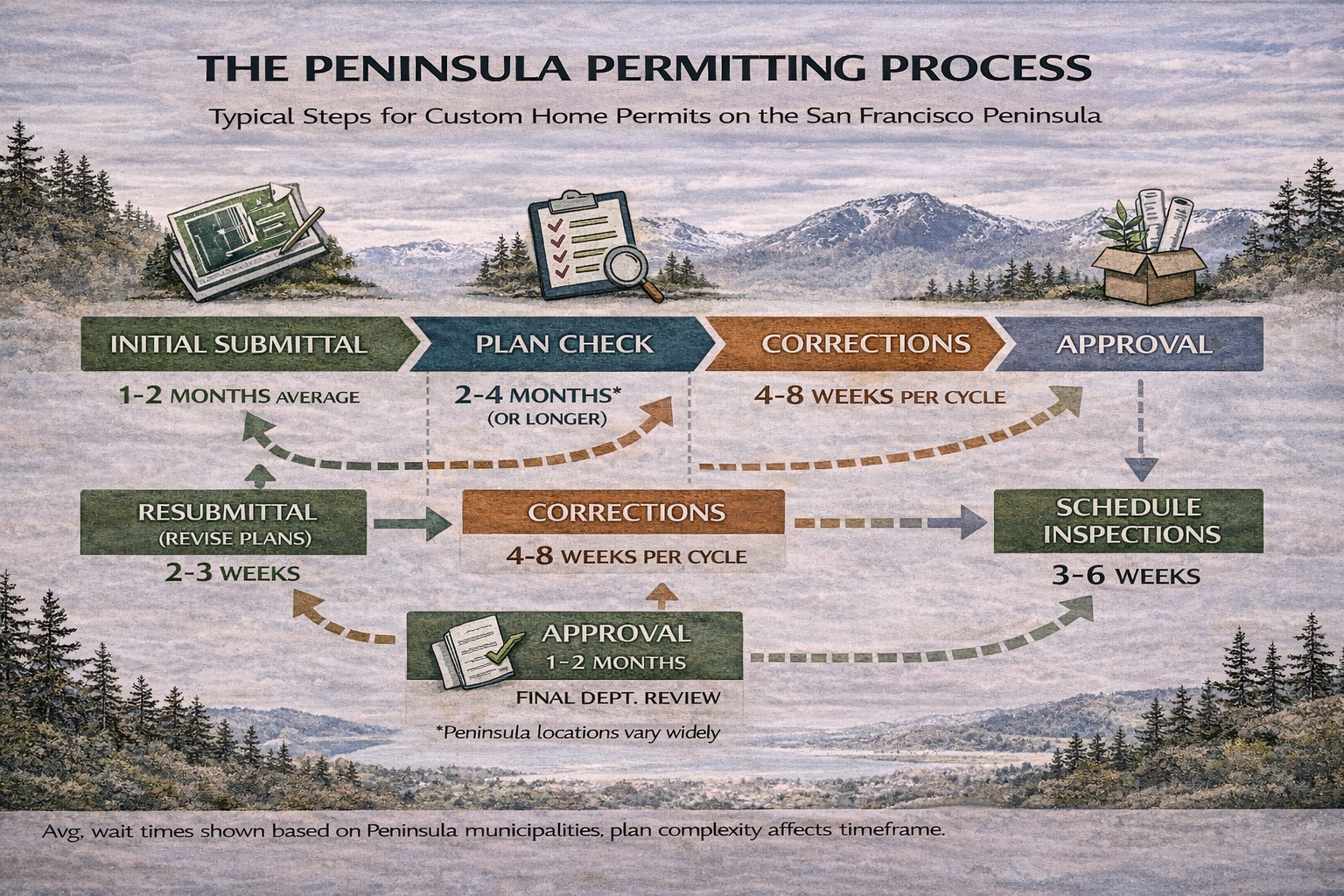
Permitting is where optimistic timelines go to die. On the Peninsula, permit approval involves more than submitting drawings to a building department. Cities like Atherton, Hillsborough, and Woodside require architectural review, sometimes through a separate design review committee that meets monthly. Miss a meeting cycle due to an incomplete plan set, and you've lost four to six weeks instantly.
San Mateo County cities routinely take 6 to 12 months for custom home permits, with some hillside communities in Santa Clara County approaching 12 to 18 months for complex projects. Multiple correction rounds are standard, not the exception, and each round can add 4 to 8 weeks to the review cycle.
Plan check corrections are nearly universal for custom homes. An incomplete soils report, an incorrect setback calculation, or a structural detail that doesn't meet the current California Building Code will trigger a correction notice, sending the drawings back to the architect. Experienced builders anticipate this and submit plans engineered to minimize corrections from the start.
Step-by-Step: How a Peninsula Custom Home Project Actually Moves Forward
- Site due diligence and feasibility: Before any design work begins, understand what the lot allows. Confirm zoning, allowable floor area ratio, setbacks, height limits, and whether the property sits in a flood zone, fire zone, or liquefaction area. This step prevents expensive design work on a project that can't be permitted as imagined.
- Select your builder and architect early: On the Peninsula, the best builders and architects have waitlists. If you're waiting until the design is done to select a contractor, you're adding three to six months to your actual start date. Engaging a design-build firm or a builder who collaborates with architects from day one eliminates this gap. Resources like choosing the right custom home builder can guide your vetting process.
- Complete the design fully before submitting for permits: Partial or preliminary permit submissions invite corrections and incomplete reviews. A fully coordinated set of architectural, structural, mechanical, electrical, and plumbing drawings submitted together moves faster and generates fewer correction rounds.
- Manage municipal timelines proactively: Know your city's planning commission and design review board meeting schedule. Submit early enough to appear on the next available agenda, not the one after that. Assign someone to track the permit status actively.
- Finalize all material and finish selections before construction starts: Long-lead items like custom windows, cabinetry, stone, and specialty hardware can take 12 to 20 weeks to fabricate and deliver. Ordering these at or before permit approval means they arrive on site when needed, not six weeks late.
- Build a realistic contingency into your schedule: Even well-run Peninsula projects encounter inspection delays, weather stoppages during grading, and subcontractor availability gaps. A 10 to 15 percent schedule buffer on the construction phase is not pessimism; it's professional planning.
What Do Custom Homes on the Peninsula Actually Cost Per Square Foot?
Custom home construction costs on the San Francisco Peninsula typically range from $600 to $1,200 or more per square foot for finished living space, depending on site conditions, structural complexity, and finish level. Hillside homes with custom foundations, extensive grading, or premium materials frequently exceed $1,000 per square foot before lot and soft costs. These figures are substantially higher than California's statewide average and reflect local labor rates, material costs, and regulatory compliance expenses unique to this market.
Understanding cost and timeline together matters because the two are deeply connected. Projects that try to compress timelines through value engineering often create downstream problems, while projects that invest properly in design coordination and permitting preparation tend to build faster once ground is broken. For a deeper look at the drivers behind these figures, the breakdown of what affects custom home costs on the Peninsula covers the key variables in detail.
How Location Within the Peninsula Affects Your Timeline
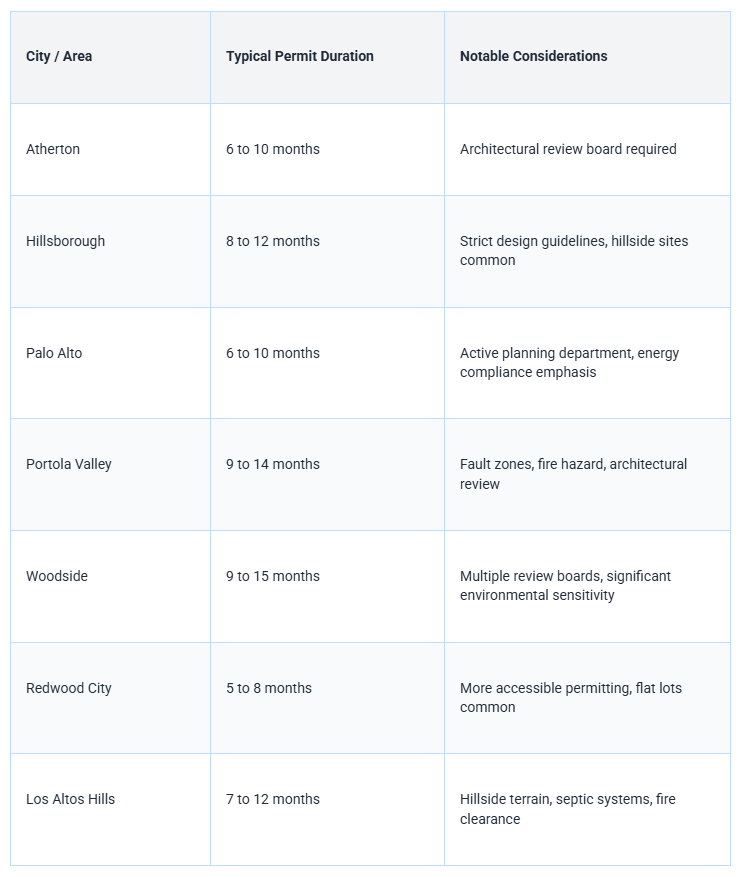
These ranges reflect typical projects without major complications. Anything involving heritage tree removal, proximity to creek corridors, or neighbor-filed appeals can extend any of these timelines by several months. Builders who regularly work across Peninsula cities know which departments move quickly and which require extra lead time, a knowledge advantage that genuinely saves months on a project schedule.
Common Mistakes That Extend Your Build Timeline
- Choosing a builder after the design is finished. This creates a gap where the builder isn't involved in design decisions that directly affect constructability and cost, leading to redesigns and delays before permits are even filed.
- Submitting incomplete permit packages. Missing structural calculations, geotechnical reports, or energy compliance documentation triggers correction notices that can cost six to ten weeks per round.
- Changing the design after permits are submitted. Even minor changes can require plan check resubmittal. Major changes during active construction can require permit amendments that halt work for weeks.
- Underestimating long-lead material timelines. Custom steel windows, European cabinetry, and specialty stone can have 16 to 24 week lead times. Ordering too late stalls finish work entirely.
- Skipping a geotechnical investigation before design. Discovering unexpected soil conditions after design is finalized can require significant foundation redesigns, resetting both the design and permitting clocks.
- Assuming the national average timeline applies here. It doesn't. Peninsula-specific regulations, geography, and construction demand create a different reality that requires Peninsula-specific planning.
Frequently Asked Questions
What is the fastest a custom home can be built on the Peninsula?
Under ideal conditions, a straightforward custom home on a flat, permit-friendly Peninsula lot with a fully resolved design could potentially be completed in 18 months total. This assumes minimal permitting corrections, no major site complications, and no significant design changes after construction begins. For most projects, 18 months represents a best case, not a typical expectation.
Why does it take so long to build in the Bay Area compared to other regions?
The Bay Area's permitting environment is genuinely more complex than most of the country, with more jurisdictions, more required reports, more review bodies, and more active neighbor participation in planning processes. Combine that with seismic engineering requirements, fire zone regulations, energy compliance standards, and a constrained labor market for skilled trades, and you have a system where speed is structurally limited regardless of how well a project is managed.
How long do permits take for a custom home on the Peninsula?
Plan for 6 to 12 months as a realistic baseline, with some hillside communities and cities with active design review processes pushing to 12 to 15 months for complex projects. Cities like Woodside and Portola Valley that require architectural committee approval on top of standard building permits tend to take longest. Working with a builder who has local permit experience can meaningfully reduce this timeline by submitting complete, well-prepared packages that minimize correction rounds.
What adds the most time to the construction phase itself?
Inspection scheduling and long-lead material delays are the two biggest sources of construction-phase time loss. When a city inspection is required before the next phase can begin and the earliest available slot is two weeks out, that gap compounds across a multi-phase build. Custom cabinetry, specialty glazing, and imported stone are frequent culprits for material delays when ordering decisions are made too late in the process.
When is the best time of year to start construction on the Peninsula?
Targeting a permit approval and construction start in spring, typically March through May, gives you the dry season for site work and foundation pours and allows interior work to proceed through winter without weather impacting the critical path. Starting site work in late fall risks grading and concrete work delays from rain. Since you can't fully control when permits are approved, planning your design and permit submission around a spring start is the most practical approach.
Final Thoughts: Plan for the Peninsula, Not the Average
The homeowners who navigate Peninsula custom builds most successfully are those who accept the real timeline from day one. Eighteen to thirty-six months is not a problem to solve; it's a reality to plan around. The projects that struggle are those built on national averages and wishful thinking, not local expertise and honest scheduling.
Working with builders who have deep roots in Peninsula municipalities, understand the permitting nuances of each city, and maintain relationships with the right engineering and design professionals is what actually moves projects forward. That's the difference between a builder who quotes you a timeline and one who consistently delivers on it. For clients considering a luxury build, seeing examples of what's achievable on the Peninsula at the highest level of craft is worth exploring what a luxury home builder San Francisco families trust can achieve.
Ready to Get a Realistic Timeline for Your Custom Home?
Supple Homes INC has guided Peninsula families through every phase of the custom home process, from site feasibility and design coordination through permitting and construction completion. We know what each city requires, what delays are avoidable, and how to build a schedule that holds.
If you're ready to talk through your project, or just want to understand what a build on your specific lot would actually look like, reach out directly. Call (650) 649-4480 to speak with the Supple Homes INC team about your timeline, your lot, and what it takes to build the home you have in mind on the San Francisco Peninsula.