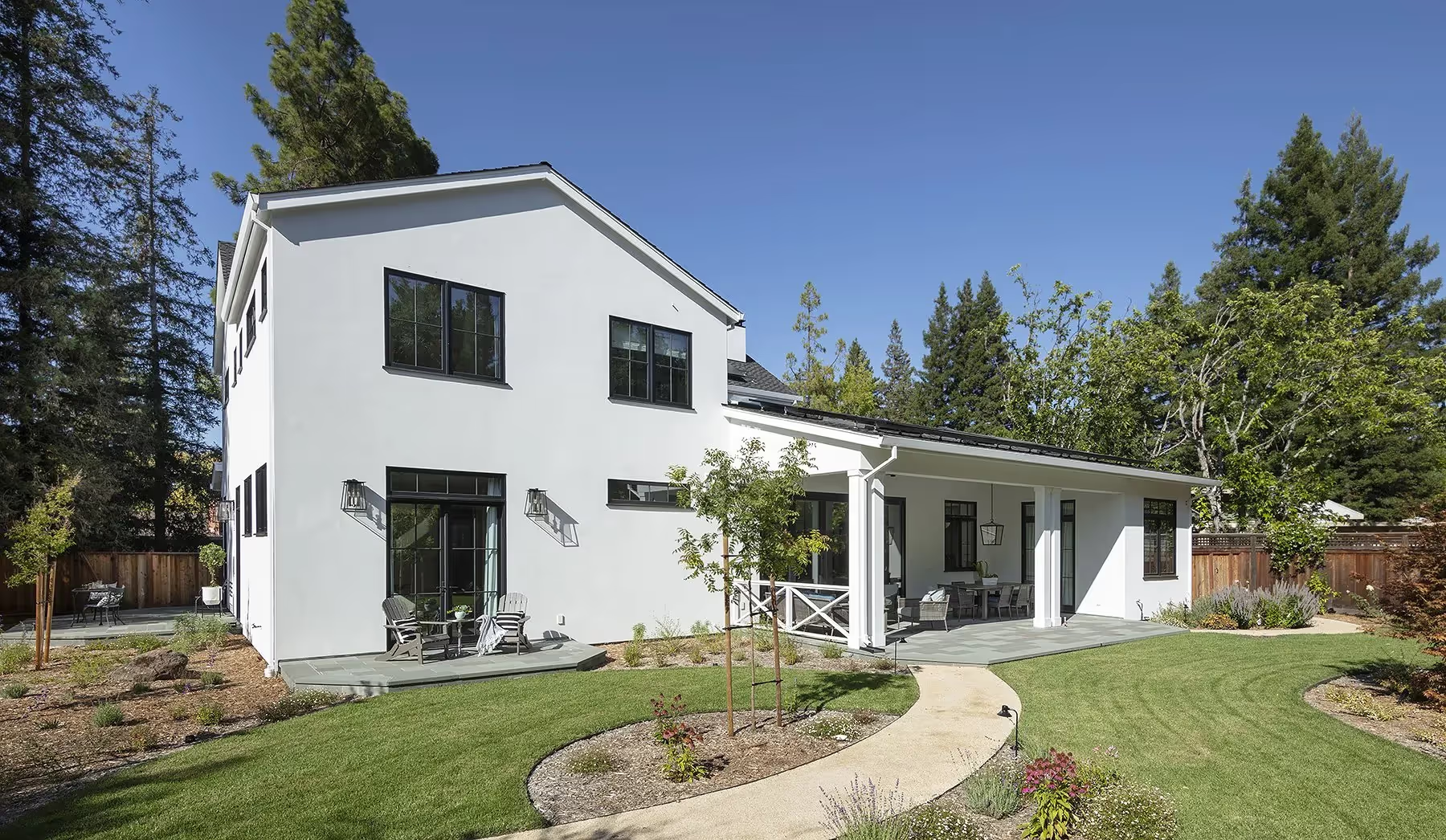
Building on a sloped lot in the San Francisco Peninsula adds complexity and cost to any construction project, but it also creates opportunities for stunning hillside homes with panoramic views. Expect to pay 20–40% more than flat-lot construction due to grading, retaining walls, and specialized foundations. With the right builder and design strategy, these challenges become manageable and even advantageous.
Sloped lots are everywhere on the Peninsula, from the hillside neighborhoods of Hillsborough and Woodside to the steeper terrain in Portola Valley and Los Altos Hills. Many buyers are drawn to these parcels for their privacy and views, only to discover that the path from raw land to finished home is far more technical than they anticipated. Understanding what you're getting into before breaking ground can save you six figures and months of delays.
Key Takeaways
- Sloped lot construction on the San Francisco Peninsula typically costs 20–40% more than equivalent flat-lot builds due to grading, drainage, and structural requirements.
- Foundation choice is critical on hillsides; caissons, grade beams, and stepped foundations each suit different slope conditions.
- Drainage and erosion control are not optional extras; they are required by most Peninsula municipalities and essential to long-term structural safety.
- Geotechnical (soils) reports are required before permits are issued and can influence foundation design significantly.
- Smart architectural design, including split-level layouts and daylight basements, can recapture value lost to slope premiums.
- Working with a builder experienced in hillside construction on the Peninsula is the single most important factor in keeping costs and timelines under control.

Why Sloped Lots Are So Common on the Peninsula
The San Francisco Peninsula sits between the Santa Cruz Mountains and the Bay, which means developable land is naturally varied in elevation. Communities like Hillsborough, Atherton, and Menlo Park have pockets of relatively flat terrain, but move further west into Woodside, Portola Valley, or Los Altos Hills and the landscape changes quickly. Many of the remaining vacant or redevelopable lots in these areas sit on slopes ranging from a gentle 10% grade to a challenging 35% or more.
Flat lots on the Peninsula are rare and priced accordingly. Sloped parcels, by contrast, are often available at a discount relative to their square footage, which makes them attractive to buyers willing to invest in proper construction. The trade-off is real, but so is the payoff: hillside homes often command premium resale prices because of their views and distinctive architecture.
What Does Slope Actually Do to Your Construction Cost?
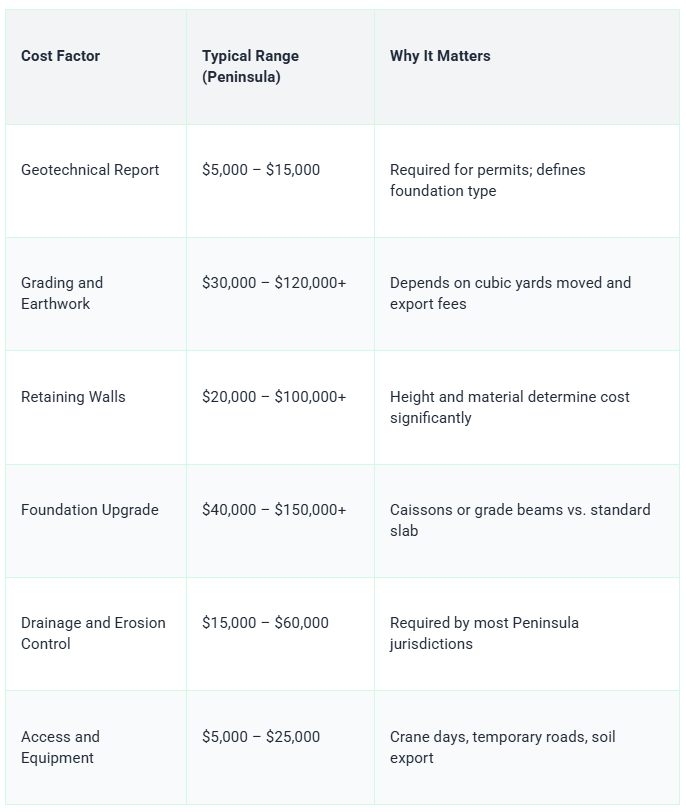
Industry estimates for the San Francisco Bay Area consistently show that construction on a moderately sloped lot (15–25% grade) adds $50,000 to $150,000 in foundation and grading costs alone compared to flat-lot construction of the same home size. Severely sloped lots above 30% can push that premium to $200,000 or more before a single framed wall goes up.
The slope premium comes from several compounding factors. Grading the site, engineering retaining walls, extending foundation depths, and getting equipment onto the lot all cost more when terrain is uneven. Labor hours increase because workers and materials move slower on hillsides.
Here is a breakdown of the primary cost drivers specific to sloped lot construction on the Peninsula:
Which Foundation Type Works Best on a Hill?
Foundation selection on sloped lots is not a preference, it is an engineering determination. Your geotechnical engineer will analyze soil composition, bedrock depth, slope stability, and seismic risk before recommending an approach. On the Peninsula, where earthquake zones overlap with challenging terrain, that report carries serious weight.
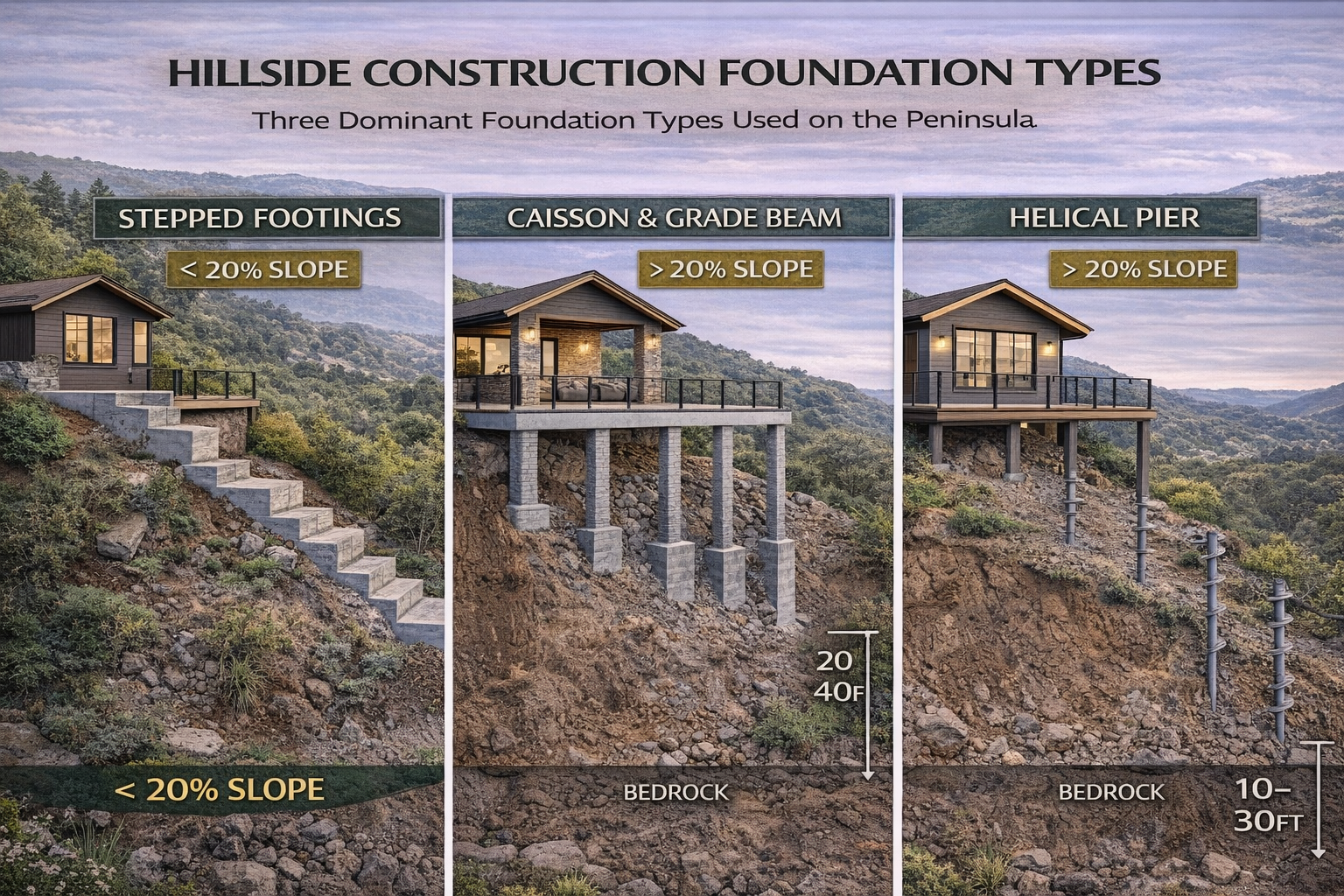
Drilled pier (caisson) foundations are among the most commonly specified systems for steep hillside homes in the Bay Area, with individual caissons often reaching 20–40 feet in depth to anchor into stable bedrock or dense soil below the unstable surface layer. A single caisson can cost $3,000–$8,000 installed, and a typical hillside home may require 20 or more.
Three foundation types dominate hillside construction on the Peninsula:
- Stepped footings: Used on moderate slopes (under 20%), these follow the contour of the land in a stair-step pattern. Less expensive than caissons and effective when soil is stable.
- Grade beams with caissons: The go-to for steeper terrain. Deep piers are drilled to bedrock and connected by horizontal concrete beams. Extremely stable and seismically sound.
- Helical piers: Steel screw piles that can be installed with minimal disturbance to the site. Used in situations where access is limited or soil conditions make drilling impractical.
How Do You Manage Water Runoff on a Hillside Property?
Water is the most destructive force acting on a hillside home over time. During winter rains, which are substantial in the Peninsula's Mediterranean climate, improperly managed runoff can undermine foundations, saturate retaining walls, and trigger slope failures. Many of the structural problems seen in older hillside homes trace back to drainage systems that were inadequate from the start.
San Mateo County and Santa Clara County both require drainage plans as part of grading permit applications for sloped lots, and most municipalities on the Peninsula have adopted C.3 stormwater requirements under the Municipal Regional Permit, mandating that new developments manage a defined volume of on-site runoff rather than directing it to the street or adjacent parcels.
Effective drainage on a hillside involves several coordinated systems working together. Surface swales and area drains intercept sheet flow before it can pool against the structure. French drains and perforated pipe systems manage subsurface water moving through the soil. Retaining wall drainage, including weep holes and gravel backfill, prevents hydrostatic pressure from building up against concrete or masonry walls.
A well-designed drainage plan is not just a permit requirement; it protects your investment for decades. Builders with real hillside experience, like the team at Supple Homes INC, integrate drainage planning into the design phase rather than treating it as an afterthought.
Step-by-Step: How a Sloped Lot Build Actually Unfolds
- Site Assessment and Feasibility: Before purchasing or designing anything, commission a topographic survey and preliminary geotechnical evaluation. This tells you what the land will actually cost to develop and whether your target home size is achievable within setback and grading limits.
- Geotechnical Report: A licensed geotechnical engineer drills soil borings or test pits, analyzes samples, and issues a report specifying allowable foundation types, bearing capacity, and any soil remediation required. This report drives foundation design.
- Architectural Design with Slope in Mind: Work with an architect who has hillside experience. Split-level plans, daylight basements, and cantilevered sections are tools that can reduce grading volume while creating dramatic interior spaces. Understanding what affects homes in San Francisco from a cost perspective helps shape realistic design decisions early.
- Grading and Drainage Permits: Submit grading plans, drainage calculations, and erosion control documentation to the local building and planning departments. On the Peninsula, this process can take 3–6 months depending on the jurisdiction and project complexity.
- Site Preparation and Grading: Once permits are in hand, the site is cleared, rough graded, and temporary erosion controls are installed. Soil export, if required, is a significant cost line at this stage.
- Foundation Installation: Caissons are drilled, grade beams are formed and poured, or stepped footings are constructed according to the engineered plans. Inspections occur at each phase.
- Retaining Walls and Drainage Systems: Permanent retaining structures are built before framing begins. Drainage infrastructure, including underground pipes and surface swales, is installed concurrently.
- Framing and Vertical Construction: With the site stabilized and foundation complete, the home proceeds much like any other custom build, though site logistics (material delivery, crane access) remain more complex than on flat ground.
Smart Design Choices That Reduce the Slope Penalty
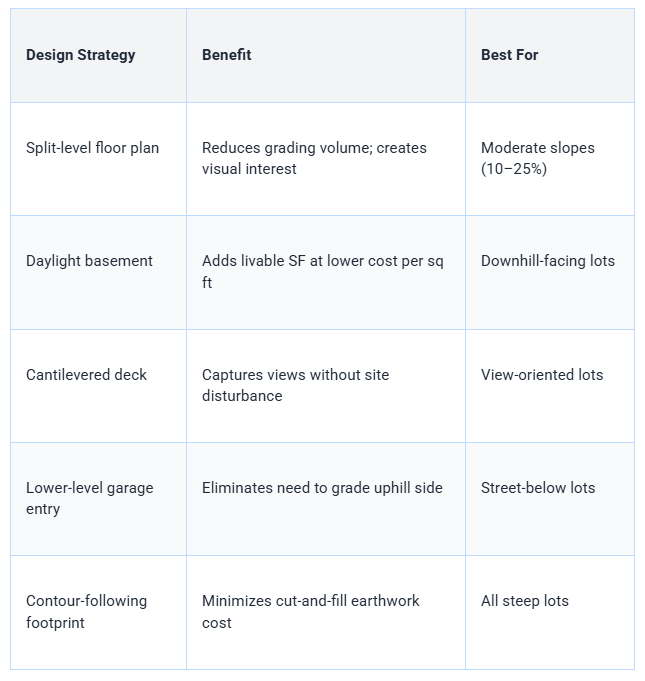
The right architectural approach can recover a significant portion of the cost premium associated with sloped lots. Skilled designers don't fight the slope, they work with it. Think about what it means when a home's lowest level becomes a full daylight basement with direct outdoor access: you gain usable square footage at a fraction of the per-square-foot cost of above-grade living space.
Homes on the San Francisco Peninsula with unobstructed hillside views have historically sold at a 10–25% premium over comparable homes on flat lots in the same zip code, partially offsetting the higher cost of hillside construction when resale value is factored into the investment equation.
Key design strategies that experienced Peninsula builders use to minimize cost while maximizing value include minimizing cut-and-fill by following natural contours, using cantilevered decks to capture views without additional grading, and locating garages at the lower level to create a natural entry point without excavating the uphill side of the lot.
If you're exploring builders who specialize in this kind of design-forward approach, understanding what makes a luxury homebuilder in San Francisco different from a production builder becomes an important part of the selection process.
Common Mistakes Homeowners Make with Sloped Lot Projects
- Skipping the geotechnical report before purchasing land. Discovering that a lot requires $200,000 in caissons after you've already closed escrow is a painful surprise that a $5,000 preliminary soils investigation could have prevented.
- Underbudgeting for grading and drainage. Many buyers use flat-lot construction cost estimates as their baseline. The slope premium needs to be baked in from day one, not discovered during bidding.
- Choosing an architect with no hillside experience. A floor plan designed for flat ground does not translate to a slope. The structural and drainage implications of every design decision are amplified on hillside sites.
- Ignoring neighbors' drainage patterns. Uphill neighbors' runoff flows onto your property. Understanding how water moves across the entire site, not just your parcel, is essential for drainage design.
- Treating retaining walls as an afterthought. Walls designed after the house plans are finalized often end up more expensive and less effective than walls integrated into the site plan from the start.
- Selecting a builder based on price alone. A low bid from a builder without hillside experience can lead to change orders, delays, and structural issues that cost far more than the original savings. Knowing how to choose the right custom home builder on the Peninsula matters especially on complex terrain.
Nearby Areas on the Peninsula Where Sloped Lots Are Common
The following Peninsula communities have significant concentrations of sloped or hillside residential lots, each with their own local permit requirements and topographic character:
- Woodside: Heavily wooded hillside parcels, often on 1+ acre lots with significant grading constraints and heritage tree protections.
- Portola Valley: Known for strict hillside development guidelines and high seismic sensitivity given proximity to the San Andreas Fault.
- Los Altos Hills: Large rural lots on rolling terrain; many properties require extensive driveway grading as well as home site preparation.
- Hillsborough: Mix of flat and steeply sloped lots; hillside parcels offer canyon or Bay views but require careful engineered design.
- Belmont and San Carlos hills: More moderately sloped terrain with active development; accessible for new construction with manageable slope premiums.
- Daly City and Pacifica hillsides: Coastal slope exposure adds wind and soil erosion considerations on top of standard hillside challenges.
Frequently Asked Questions
How much extra does it cost to build on a slope?
On the San Francisco Peninsula, building on a sloped lot typically adds 20–40% to total construction costs compared to a flat-lot project of equivalent size. The premium comes primarily from grading, specialized foundations, retaining walls, and drainage systems. Steeper lots or those with challenging soil conditions can push that figure higher.
What is the best foundation type for a sloped lot?
There is no single "best" foundation; the right choice depends on your specific soil conditions, slope degree, and seismic zone. For most steep hillside sites on the Peninsula, drilled caissons with grade beams are the most stable and commonly specified solution. A licensed geotechnical engineer will determine the appropriate system based on soil boring results and your structural engineer's requirements.
How do I manage water runoff on a hillside?
Effective hillside drainage combines surface swales, area drains, French drains, and retaining wall drainage into an integrated system. Peninsula municipalities require a drainage plan as part of grading permit applications, and many jurisdictions require on-site stormwater retention under regional permit rules. A civil engineer experienced in local requirements should design this system concurrently with the architectural plans.
Are permits more difficult to obtain for sloped lot construction?
Generally, yes. Sloped lot projects require geotechnical reports, grading permits, drainage plans, and sometimes additional review under hillside development ordinances, in addition to standard building permits. Processing times on the Peninsula can run 3–6 months or longer depending on the jurisdiction and project complexity. Starting the permit process early and working with a builder familiar with local agencies makes a significant difference.
How do I make sloped lot construction more cost-effective?
The most effective strategies are designing the floor plan to follow natural contours (minimizing cut-and-fill volume), incorporating the slope into the architecture rather than fighting it, integrating drainage and retaining wall design from day one, and choosing a builder with genuine hillside experience who can anticipate and prevent expensive surprises. Investing in thorough pre-design due diligence, including surveys, soils reports, and feasibility studies, consistently saves money at the construction phase.
Final Thoughts: Hillside Homes Are Worth Getting Right
Building on a sloped lot on the San Francisco Peninsula is genuinely more complex and more expensive than building on flat ground. But complexity handled well produces homes that are structurally sound, beautifully integrated into their landscape, and among the most sought-after properties in the region. The views, the privacy, and the architectural character that hillside sites make possible are real advantages that the market consistently recognizes.
The key is entering the process with clear eyes about cost, timeline, and the expertise required. Sloped lot construction rewards thorough planning and punishes shortcuts. With the right team, those challenges become the foundation of something exceptional.
Ready to Build on Your Sloped Lot?
Supple Homes INC has extensive experience designing and building custom homes on challenging hillside terrain throughout the San Francisco Peninsula. From the initial feasibility review through final walkthrough, the team brings the engineering knowledge, local permit experience, and design sensibility that sloped lot projects demand.
Call (650) 649-4480 to speak with a Supple Homes INC specialist about your lot, your vision, and what it will realistically take to build it right.