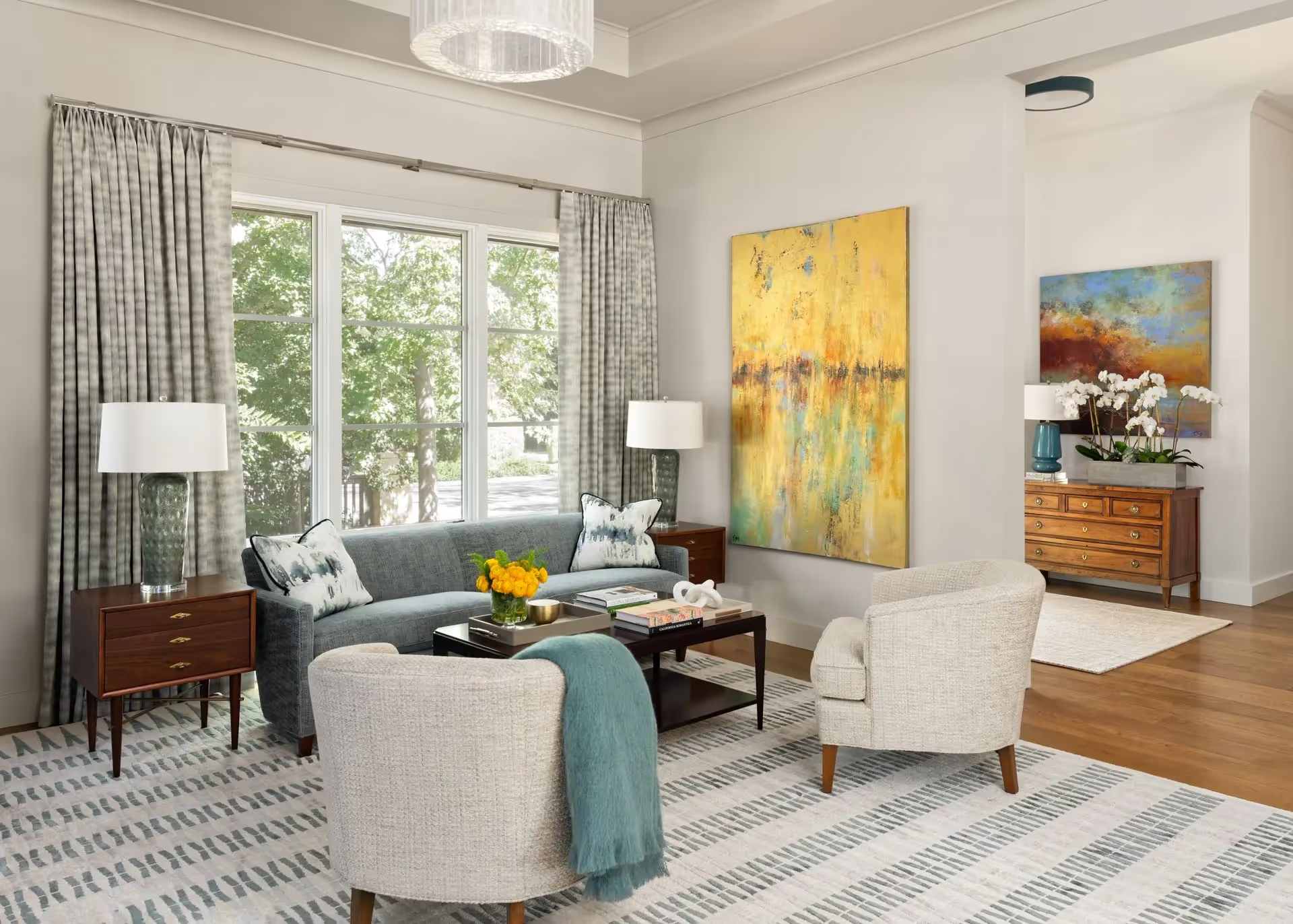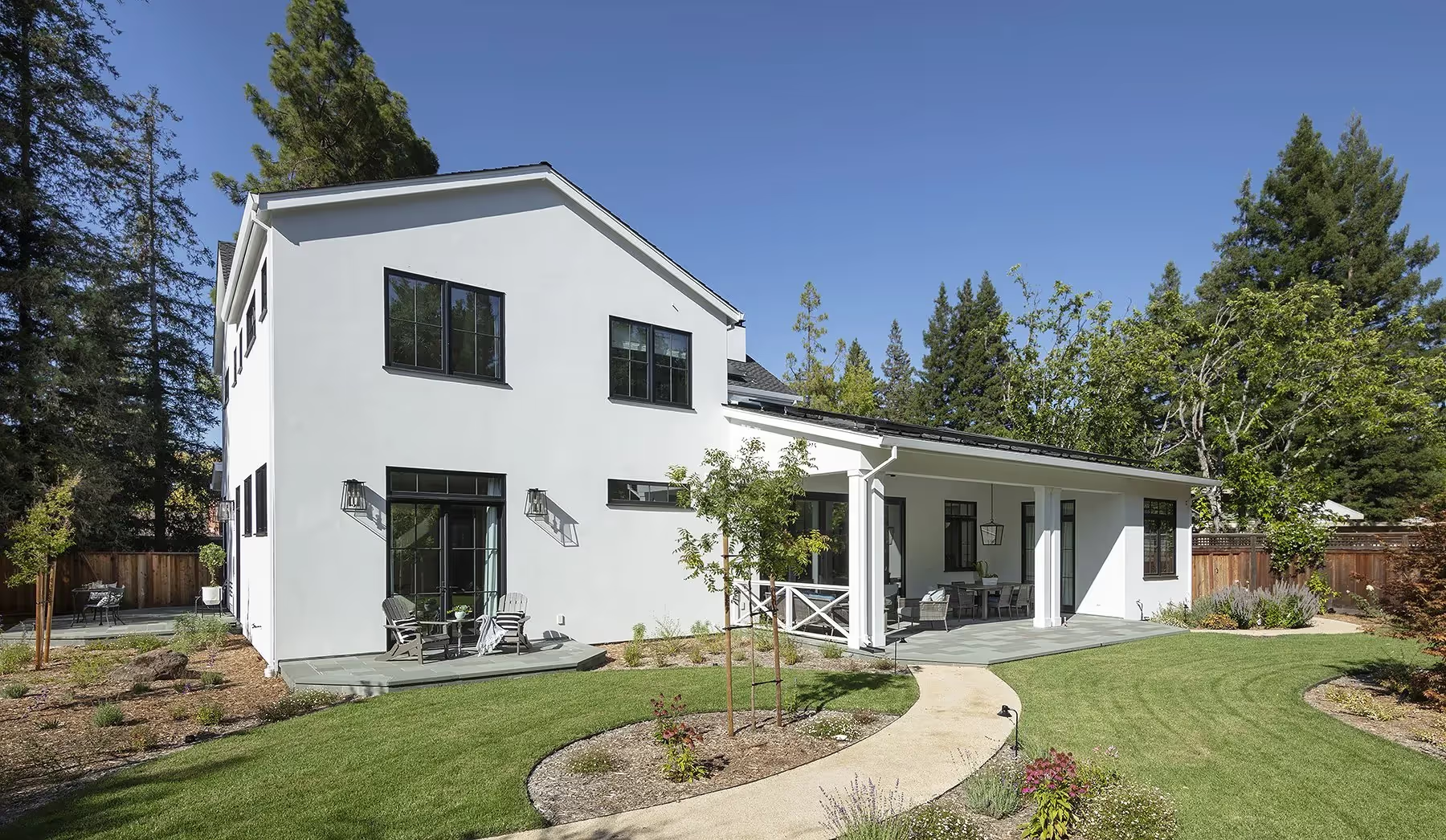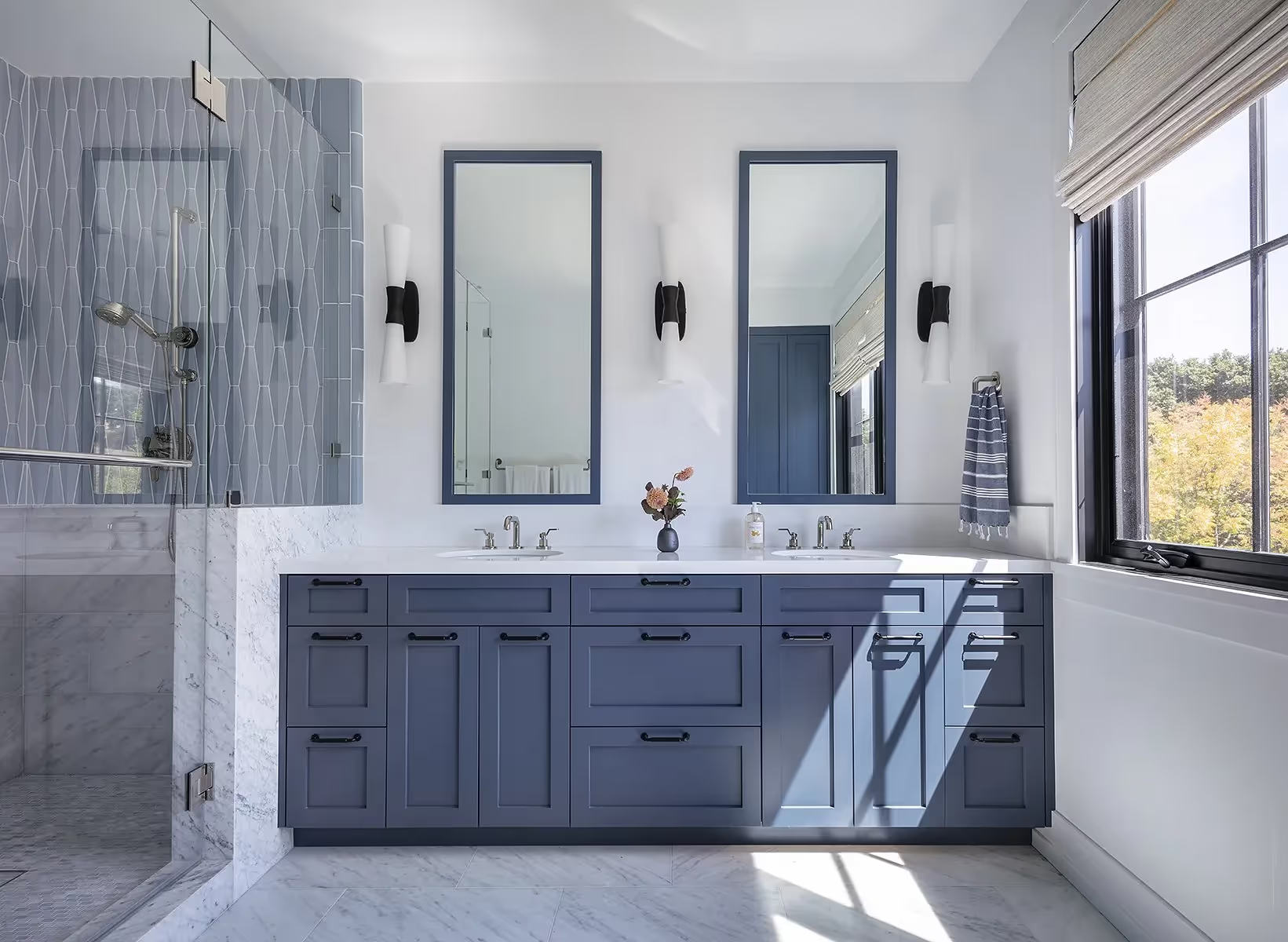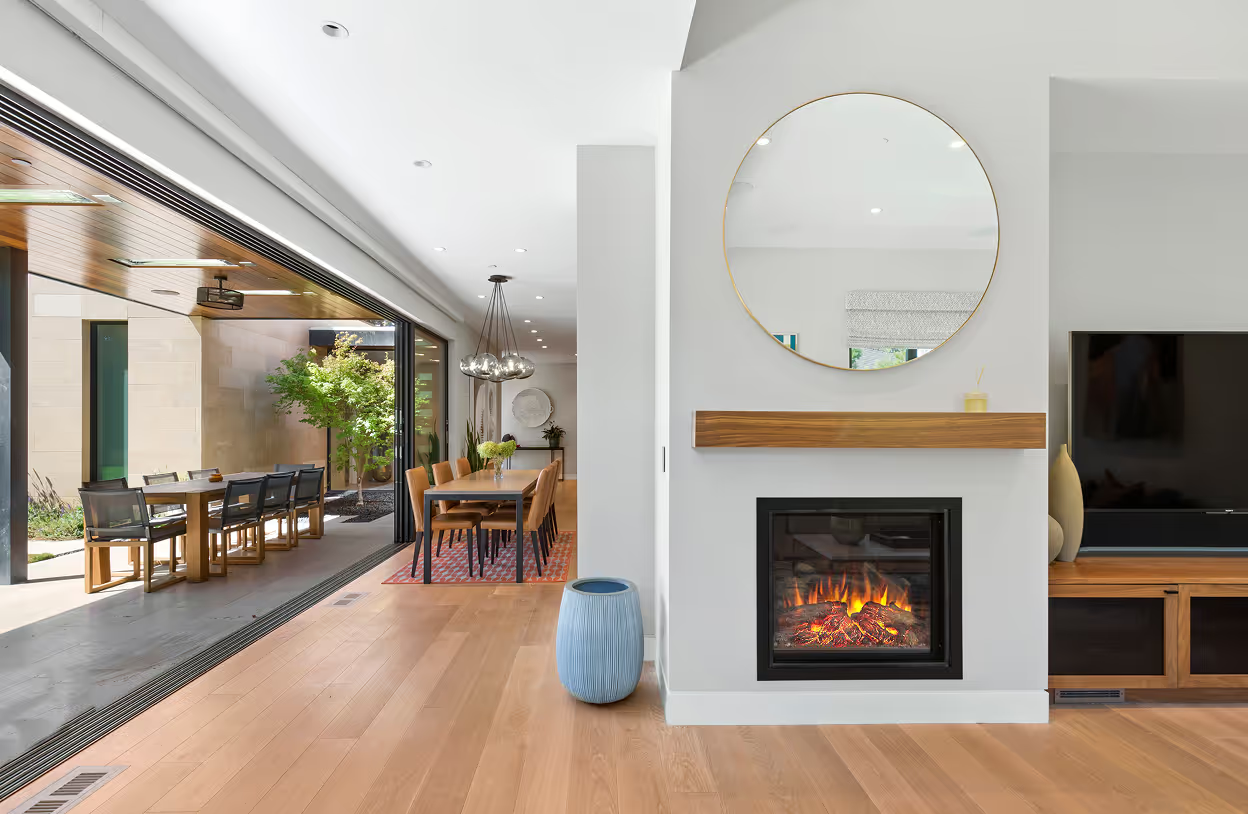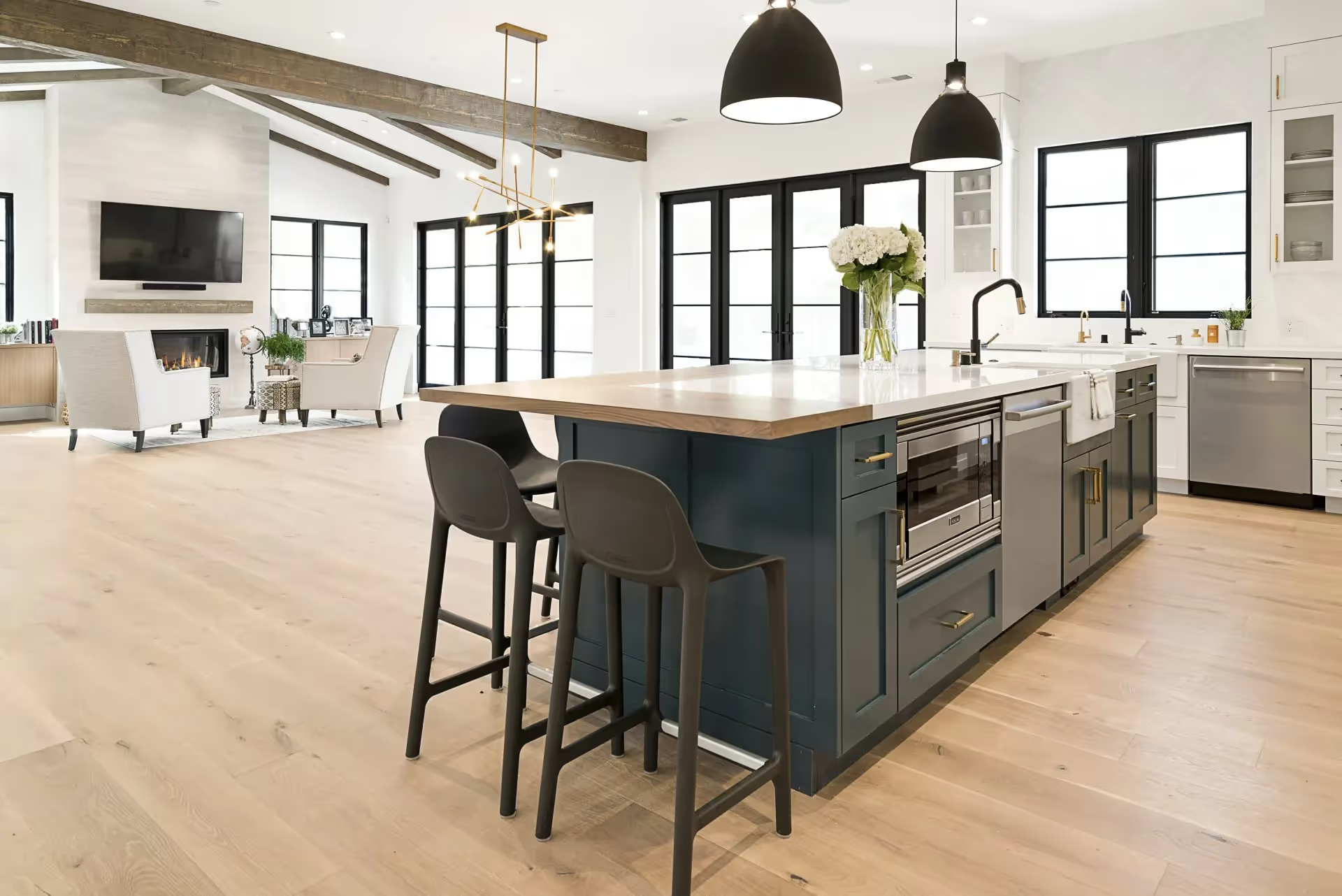
In the Bay Area, custom homes generally hold their value better than comparable tract homes, provided they're built with quality materials, thoughtful design, and features aligned with local buyer demand. Resale performance depends heavily on location, finish quality, and how well the home fits neighborhood price ceilings. When built strategically, a custom home can deliver both lifestyle value and long-term equity.
Most Bay Area homeowners think about value in terms of square footage and ZIP code. But those who've commissioned a custom build often discover a third factor that rarely shows up in listing data: the compounding advantage of owning a home built specifically for your land, your lifestyle, and your market. Whether you're weighing a custom build against a resale purchase or comparing it to a major renovation, the question of long-term value retention is worth examining carefully.
Key Takeaways
- Custom homes in premium Bay Area markets tend to outperform tract homes in resale value when built with high-quality finishes and energy-efficient systems.
- Appraisals for custom homes can be challenging because there are fewer direct comparables, but unique features often support higher valuations.
- Overbuilding for the neighborhood is one of the most common ways custom homeowners lose value at resale.
- Energy efficiency, outdoor living integration, and smart home systems are among the features Bay Area buyers most consistently pay a premium for.
- The resale timeline for a custom home is typically longer than a move-in-ready property, but the price ceiling is also higher.
- Working with an experienced local builder who understands Bay Area buyer preferences is the most reliable way to protect long-term resale value.
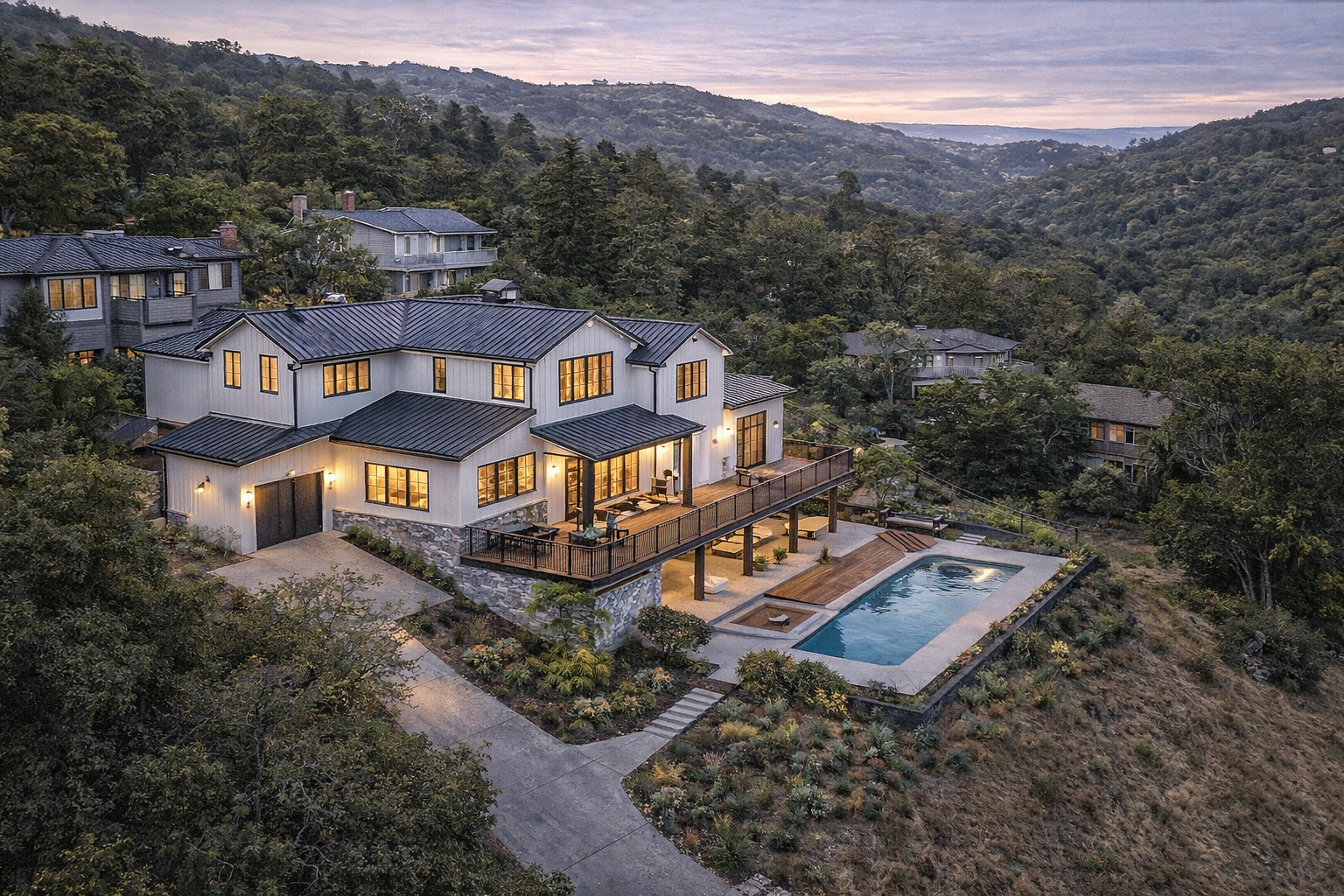
How Does the Bay Area Market Treat Custom Homes at Resale?
The Bay Area real estate market operates differently from almost anywhere else in the country. Price floors are high, buyer expectations are sophisticated, and demand for quality is consistent even when the broader market softens. That context matters when evaluating how custom homes perform.
Studies of comparable sales in high-demand California markets show that custom-built homes sell for 10% to 20% more per square foot than builder-grade tract homes in the same ZIP code, assuming the custom home was designed to match local buyer preferences rather than the personal taste of the original owner alone.
That gap closes significantly when a custom home features highly specific design choices that appeal to a narrow buyer pool. A wine cellar that takes up 400 square feet of livable space, or an unusually configured floor plan, can make the home harder to appraise and harder to sell at the top of the range.
The builders who understand this distinction build homes that feel personal without being limiting. That's a skill as much as it is a philosophy, and it's what separates a custom home that appreciates predictably from one that stalls on the market.
What Actually Drives Long-Term Value in a Bay Area Custom Home?
Value retention in the Bay Area isn't driven by square footage alone. Buyers in markets like Palo Alto, Los Altos, and Menlo Park are evaluating total livability, system quality, and how the home will age. A few factors consistently show up in high-performing resales.

Notice that the outdoor living spaces category consistently ranks among the top value drivers. In a market where buyers are paying $2M or more for a home, having an interior that flows naturally into a well-designed exterior isn't a luxury add-on; it's an expectation that affects perceived value immediately.
The Appraisal Problem: Why Custom Homes Are Harder to Value
One honest challenge with custom homes is the appraisal process. Appraisers work from comparable sales, and by definition a custom home is different from everything around it. This can create friction both during construction financing and at resale.
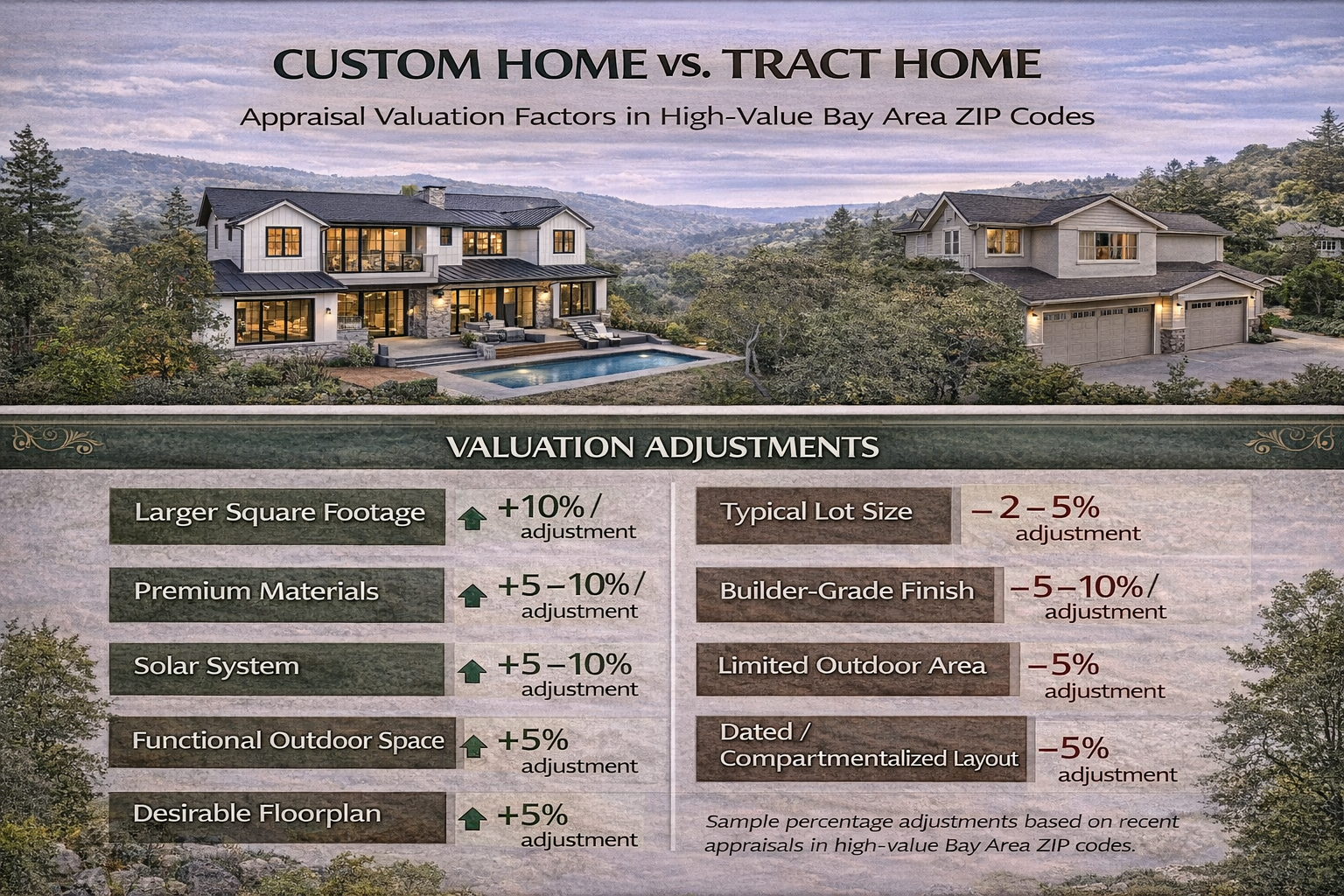
In high-value California markets, appraisers working with luxury custom homes frequently apply upward adjustments of 5% to 15% for features like premium material packages, solar systems, and functional outdoor spaces, provided there are documented comparables within a reasonable radius to anchor the base valuation.
The practical takeaway for Bay Area homeowners is this: the closer your custom home stays to the design language of the neighborhood while still distinguishing itself, the cleaner your appraisal experience will be. A luxury interior finish package that elevates without alienating is the sweet spot most experienced local builders aim for.
Step-by-Step: How to Build a Custom Home That Holds Its Value
Value retention doesn't happen by accident. It's the result of deliberate decisions made at every stage of the process, starting well before ground is broken.
- Research neighborhood price ceilings before finalizing your budget. Know the highest-performing comps in your immediate area. This sets the upper boundary of what the market will support, no matter how well you build.
- Prioritize systems over finishes in the early budget allocations. A high-performance HVAC, solid structural framing, and quality insulation will serve buyers for decades. Surface finishes can be updated; systems are much harder to replace after the fact.
- Design with the next buyer in mind from the beginning. Your architect and builder should challenge you when a design decision serves only your personal taste and not broader market appeal.
- Invest in energy efficiency certifications. Features like solar, high-efficiency windows, and whole-home battery backup are increasingly standard expectations in Bay Area markets, and they're documentable for future appraisals.
- Document everything during construction. Material specifications, warranty information, system documentation, and architectural drawings all add credibility at resale and support higher valuations.
- Work with a builder who knows your specific market. A builder experienced in high-performance homes in Bay Area neighborhoods understands what drives buyer behavior locally, which is knowledge that translates directly into resale value.
Common Mistakes That Hurt Custom Home Resale Value
Even well-built custom homes can underperform at resale if certain decisions weren't made carefully during the planning phase. These are the most common pitfalls Bay Area custom homeowners encounter.
- Over-personalizing the floor plan. Removing bedrooms to create a single oversized primary suite, for example, can shrink your buyer pool significantly at resale.
- Underestimating permit and inspection documentation needs. Buyers and their agents in the Bay Area are thorough. Gaps in permits or undocumented work become major negotiating leverage points.
- Ignoring HOA restrictions on architectural style. In communities with design review boards, non-conforming homes face challenges both at permitting and at resale.
- Cutting corners on mechanical and structural systems to fund higher visible finishes. Sophisticated buyers in premium markets hire inspectors who identify exactly this trade-off.
- Not accounting for site-specific risks. Hillside stability, fire hazard zone requirements, and drainage planning are non-negotiable in many Bay Area locations and must be addressed in the original design.
Real estate data from the San Francisco Bay Area consistently shows that homes with open-concept layouts, dedicated home office space, and ADU potential sell at a faster pace and closer to list price than comparable homes lacking those features, reflecting a post-2020 shift in buyer priorities that has remained stable.
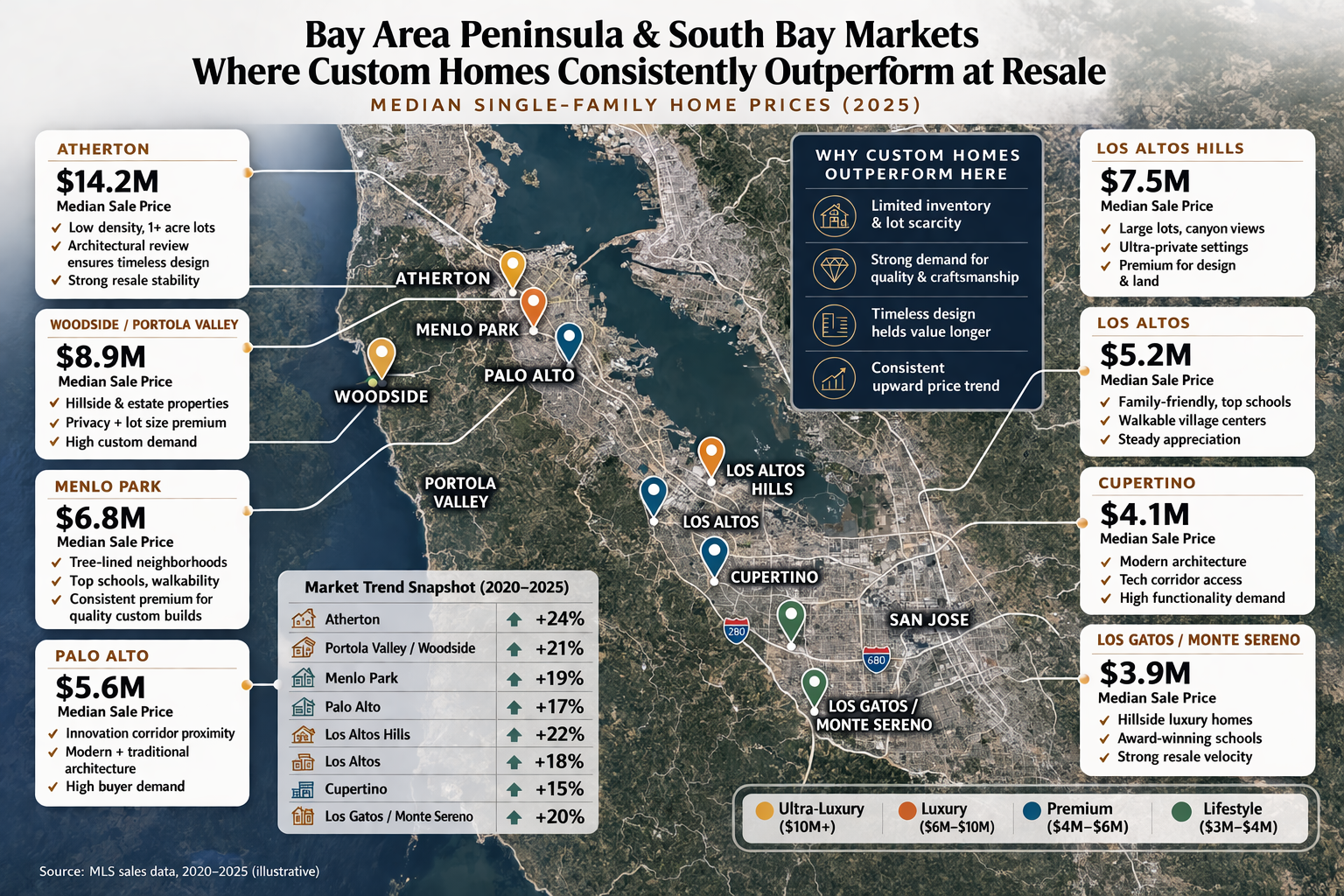
Nearby Bay Area Markets Where Custom Homes Perform Strongly
Custom home value retention isn't uniform across the Bay Area. Certain submarkets have conditions that make a well-built custom home an especially strong long-term asset.
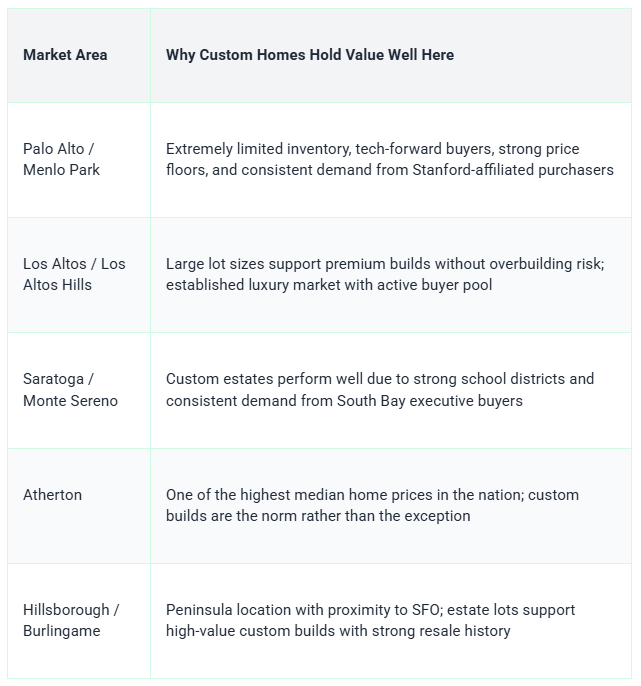
Atherton has ranked among the top three most expensive ZIP codes in the United States for multiple consecutive years, with median sale prices well above $7 million. In that environment, custom-built homes represent the dominant share of residential transactions, meaning resale comparables are built around custom construction standards rather than tract home benchmarks.
Frequently Asked Questions
Does a custom home appraise higher than a neighboring tract home?
It can, but it's not automatic. Appraisers rely on comparable sales, so a custom home only receives credit for premium features when there are nearby comps to anchor the base value. In markets like Palo Alto or Los Altos Hills where custom builds are common, this is less of an issue. In neighborhoods where your custom home is the only one of its kind, appraisers may apply conservative adjustments that undervalue what you've built.
Are custom homes "worth it" in the current Bay Area market?
For buyers who plan to stay at least 7 to 10 years and who build thoughtfully, yes. The Bay Area's limited land supply, high construction costs, and affluent buyer base all support long-term value retention for quality custom homes. The risk isn't so much market timing as it is build quality and design decisions. A well-executed custom home in the right Bay Area market is one of the more defensible long-term real estate investments available.
Do custom homes sell faster?
Not necessarily faster, but often at a higher price per square foot. Custom homes attract a more selective buyer who takes longer to commit but who also tends to be a stronger, less contingent buyer. In the Bay Area, where all-cash and low-contingency offers are common, a well-presented custom home often generates competitive offers without the same urgency-based pricing pressure that affects standard listings.
How does a custom build compare to remodeling an older home?
A full custom build gives you control over structural systems, layout, energy performance, and long-term maintenance in ways that even a comprehensive renovation can't fully replicate. Older Bay Area homes often carry deferred maintenance, outdated systems, and layout constraints that a remodel works around rather than solves. For lots in desirable locations where the existing structure is outdated, a teardown-and-rebuild frequently delivers better long-term value than a remodel at a similar investment level.
How do I ensure my custom home holds its value?
Start by understanding your neighborhood's price ceiling and designing within it. Prioritize high-performance structural and mechanical systems over purely aesthetic choices. Build features that appeal broadly to Bay Area buyers: energy efficiency, flexible living spaces, ADU potential, and strong indoor-outdoor flow. Finally, document your build meticulously, because a future buyer's appraiser and inspector will both benefit from comprehensive records, and that transparency translates directly into pricing confidence.
Final Thoughts on Custom Home Value in the Bay Area
A custom home built with market awareness and genuine quality is one of the strongest long-term value propositions in Bay Area real estate. The key isn't just building something beautiful; it's building something that a future buyer will recognize as exceptional, too.
That requires knowing the market, understanding what drives appraisals locally, and making design decisions that balance personal vision with broad appeal. It's a nuanced process, and the difference between a custom home that appreciates reliably and one that stalls at resale often comes down to who helped you make those decisions from the beginning.
Ready to Build a Custom Home That Holds Its Value?
At Supple Homes INC, we specialize in custom homes designed specifically for Bay Area buyers and Bay Area markets. From Peninsula lots in Menlo Park to hillside properties in Los Altos Hills, we understand what makes a custom home perform at resale and build with that knowledge baked into every decision.
If you're exploring a custom build and want an honest conversation about what your project could look like, call us at (650) 649-4480. We're happy to walk through your site, your goals, and what the market supports before you commit to anything.